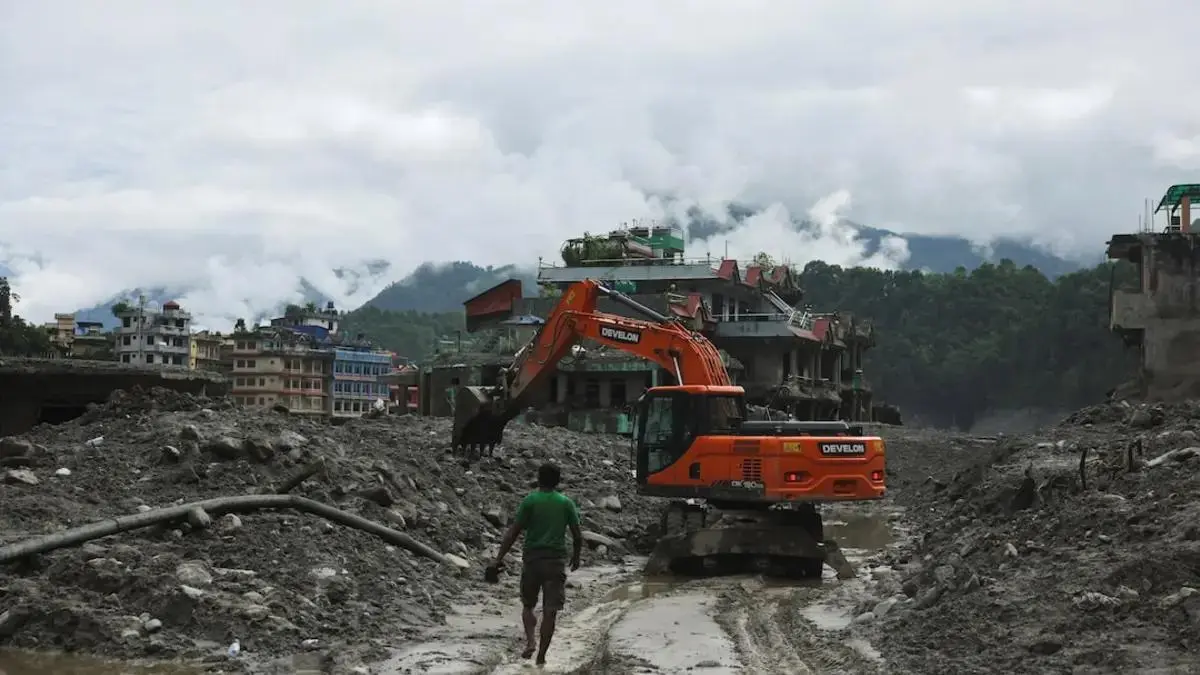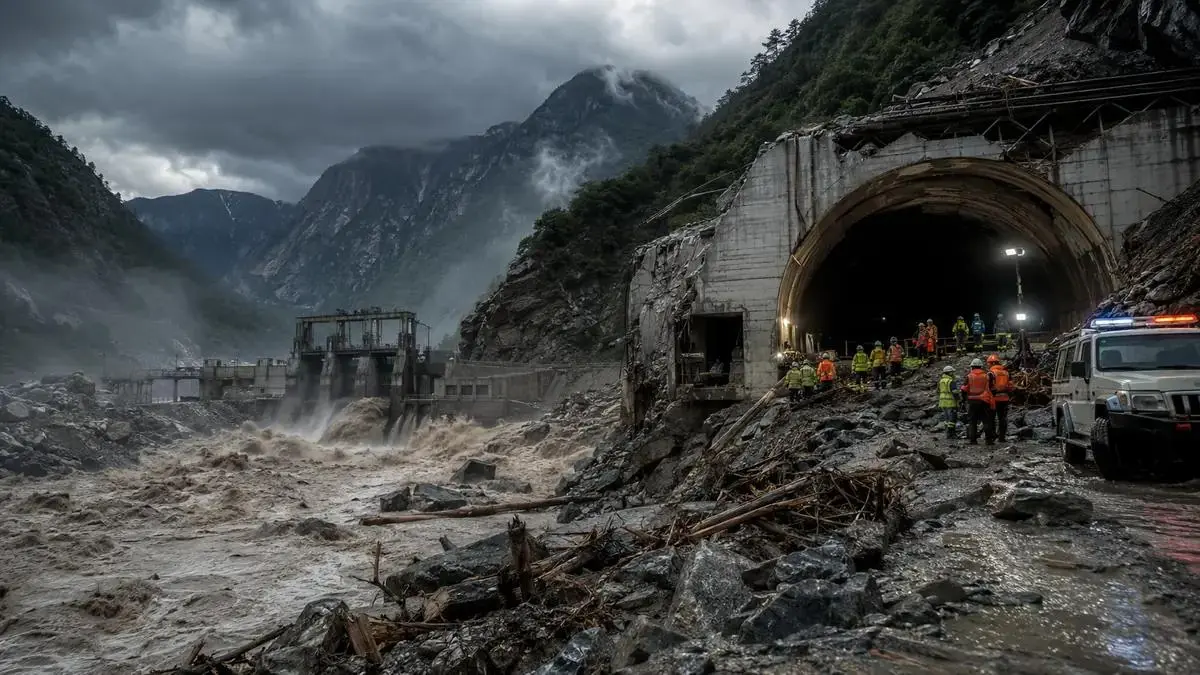
Rescue teams in Nepal are racing against time to reach hundreds of workers feared trapped inside hydropower tunnels after catastrophic flooding struck the Himalayan border with China. The August 31 operation has become one of the most urgent phases of a disaster that has killed more than 900 people in Nepal and China and left thousands missing.
The flood hit on August 26 after a mass of rock, ice, mud and debris collapsed into river systems near the Nepal–China border. Scientists and authorities are still examining the precise trigger. Early assessments point to glacier instability, while the seismic signal initially reported as an earthquake was later linked to the collapse itself.
As of Monday, Reuters reported 903 deaths in Nepal and 16 in China's Tibet region. Nearly 5,000 people remained missing across the two countries. The figures are likely to change as teams regain access to isolated valleys and search areas buried under mud and debris.
Why the rescue is focused on hydropower tunnels
The hardest rescue operations are concentrated in Nepal's Rasuwa and Nuwakot districts, where a chain of hydropower projects sits along the Bhote Koshi and Trishuli river corridors. Floodwater and debris damaged roads, bridges, power stations and tunnel entrances, cutting off workers at multiple sites.
Officials estimate that about 933 hydropower workers are missing. Not all are confirmed to be inside tunnels, but rescuers believe many may have taken shelter in underground sections as the flood swept through project sites.
At the 216-megawatt Upper Trishuli-1 project, around 250 people were rescued over the weekend. Teams are also working at Upper Trishuli-3A and Upper Trishuli-3B, where tunnel entrances have been blocked by mud, rock and twisted infrastructure. Army engineers have used controlled blasting and excavation equipment to open access routes.
The tunnels offer both hope and danger. Underground chambers may have protected workers from the initial force of the flood, but blocked ventilation, rising water, unstable debris and limited access make every hour important. Rescue teams must also avoid triggering further collapses while cutting through sealed entrances.
India, China and South Korea join the response
The operation has developed into a multinational rescue effort. Nepalese security forces and emergency teams are being assisted by specialists and equipment from India and China. South Korean personnel are involved because South Korean investors back the Upper Trishuli-1 project.
Chinese experts are supporting work at some tunnel sites, while India has provided aerial and technical assistance. The international role is significant because Nepal initially limited broad foreign assistance but accepted specialised help for tunnel rescue and access in difficult mountain terrain.
More than 10,000 people, including hundreds of foreign nationals, have reportedly been rescued since the disaster began. However, hundreds of foreigners from dozens of countries remain listed as missing. The border corridor is used by tourists, trekkers, pilgrims and trade traffic travelling between Nepal and Tibet, giving the disaster an impact far beyond the affected districts.
Families outside Nepal and China are monitoring official lists, while embassies seek information about missing citizens. Authorities have warned that communications remain unreliable in some areas, meaning a missing-person listing does not always confirm that someone was caught in the flood.
What caused the Nepal–China border flood?
Researchers are treating the event as a complex cryosphere disaster rather than a routine monsoon flood. The International Centre for Integrated Mountain Development said the flood struck Rasuwa and the Kyirong border area and travelled through the Bhote Koshi into the Trishuli river system.
Satellite analysis and field assessments indicate that a glacier or glacier-adjacent slope collapse may have released a huge volume of ice, rock and water. The moving mass then collected additional sediment and debris as it descended, creating a destructive flood wave.
Climate change does not explain every individual collapse on its own, and scientists will need time to establish the full sequence. But rising temperatures are increasing instability across the Hindu Kush Himalaya by accelerating ice loss, thawing frozen ground and changing glacial lakes. Heavy rainfall can add further pressure to already fragile slopes.
The disaster has renewed calls for stronger cross-border monitoring. Water, ice and debris do not stop at national boundaries, so downstream communities need rapid information about glacier movement, lake formation and sudden river-level changes upstream.
Nepal has pushed for more real-time data sharing with China, including earlier warnings about hazards developing in Tibet. China says it has shared information and is supporting the response. Experts argue that a permanent warning system would be more effective than relying on emergency communication after a collapse has already begun.
Hydropower damage could affect Nepal's energy system
Hydropower is central to Nepal's electricity supply and export plans. The flood damaged at least 11 project sites and may have taken roughly 700 megawatts of capacity offline, according to early estimates cited in international reporting. That is about a tenth of the country's generating capacity.
The immediate priority is saving lives, but the longer-term damage could disrupt power supply, delay construction and create large repair costs. It may also force developers and lenders to reconsider how Himalayan projects assess glacier, landslide and extreme-flood risks.
Many hydropower plants use long tunnels to divert fast-moving mountain rivers through turbines. This design is efficient, but the projects depend on roads, bridges, transmission lines and portal structures built in narrow valleys. A single high-energy debris flow can damage several connected assets at once.
For governments and investors worldwide, the event is a warning that renewable-energy infrastructure must be designed for a rapidly changing climate. Clean energy remains essential, but projects in high-risk mountain regions need stronger monitoring, safer worker shelters, redundant escape routes and disaster plans that account for events beyond historical records.
What happens next
Rescuers are expected to continue drilling, blasting and clearing tunnel entrances while weather and slope conditions allow. Teams are also checking temporary lakes and unstable debris upstream for signs of another sudden release.
The number of confirmed victims and missing people will remain fluid. Identification is difficult, roads are blocked and some families have not been able to contact relatives. Readers should rely on updated statements from Nepalese and Chinese authorities and established international news organisations rather than unverified social-media lists.
The story is now about two races: the immediate effort to reach people who may still be alive inside hydropower tunnels, and the longer effort to build a cross-border warning system before another Himalayan collapse sends danger downstream.
This report was updated on August 31, 2026. Casualty and missing-person figures may change as rescue operations continue.