Rescuers in Nepal have restored access to some remote communities and pulled nearly 300 workers from damaged hydropower sites, almost a week after catastrophic floods and a glacier collapse devastated the Himalayan border region with China.
The crisis is far from over. About 600 people remain stranded at several hydropower stations, according to the latest government figures reported by Reuters. Prime Minister Balendra Shah says at least 939 people have been killed and more than 11,000 rescued across the affected region.
Temporary bridges, repaired roads and heavy earth-moving equipment are allowing teams to reach places that were cut off by mud, rock and water. Electricity and communications have also returned in some areas, improving coordination between rescue units and local authorities.
Nepal floods: latest figures
- At least 939 people have been killed
- More than 11,000 people have been rescued
- 279 hydropower workers have been brought out
- About 600 people remain stranded at damaged hydropower sites
- Authorities initially estimated close to 1,000 workers were trapped at the projects
- More than $42 million in international aid has reached Nepal
- India and China are helping with rescue and access operations
The figures may change as teams enter previously inaccessible locations. Recovery crews are continuing to find victims beneath collapsed structures and layers of debris.
Where rescue efforts are focused
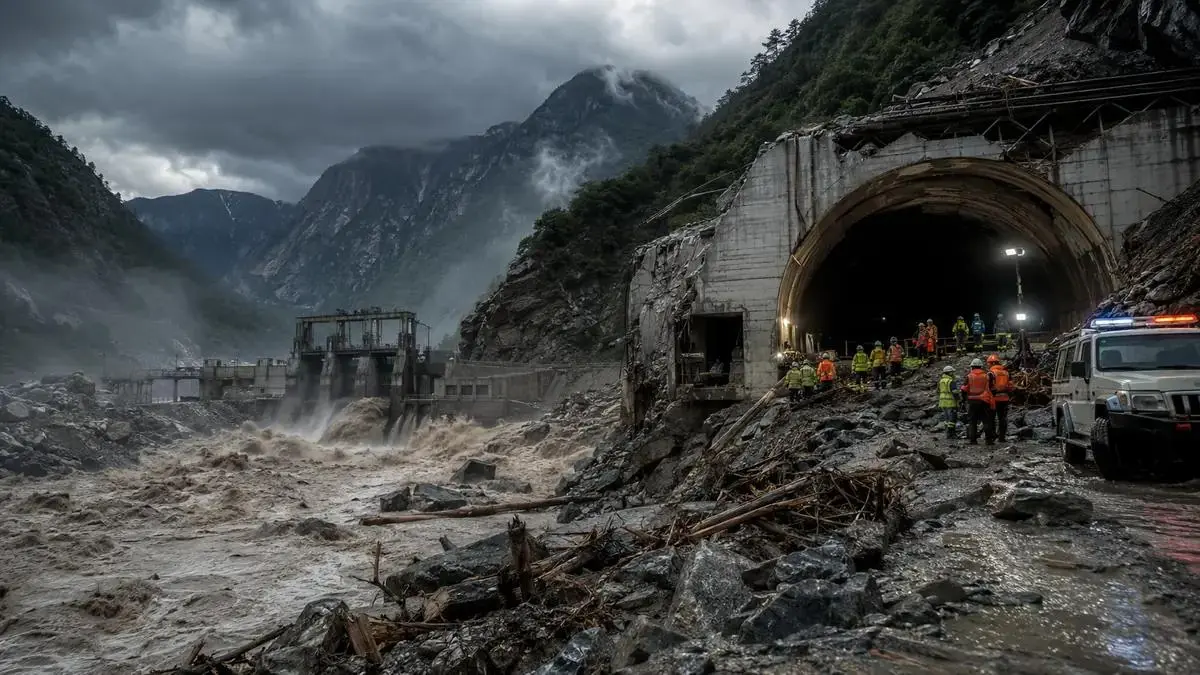
Hydropower stations have become the centre of the emergency response. Nepal's steep Himalayan terrain allows power projects to generate electricity by directing water through tunnels between mountain rivers and lower powerhouses.
That same design creates extreme danger when a flood carries mud, boulders and ice into project sites. Workers can become isolated inside tunnels or cut off when access roads and bridges disappear.
Rescue footage shows excavators digging through mud and rock after dark while soldiers use lights to search for safe entry points. The operation requires teams to remove debris without causing further collapse or releasing trapped water.
Authorities say 279 workers have been rescued from the hydropower projects. The remaining stranded people are spread across several damaged stations, so crews must conduct multiple complex operations rather than one central evacuation.
Roads and temporary bridges reopen access
The government says road links have been restored to Nuwakot, one of the worst-hit districts. That allows ambulances, rescue teams and relief trucks to move into communities that had been reachable only by air or on foot.
India and China are assisting Nepal, including by helping construct Bailey bridges. These modular steel bridges can be assembled relatively quickly where permanent crossings have been destroyed.
Restoring a road does more than accelerate search operations. It makes it possible to move food, clean water, medicine, fuel and temporary shelter materials in larger quantities. It also creates routes for injured residents and displaced families to leave unstable areas.
However, every reopened corridor must be assessed for landslide and flood risk. Damaged mountain slopes can remain dangerous long after rain stops, and heavy vehicles may place additional stress on weakened roads.
What caused the disaster?
Officials have linked the initial deluge to a glacier collapse that sent ice, rock, mud and water through Nepal's border region with China.
China's state broadcaster said the event was caused by glacier instability under the long-term effects of global warming. Nepal's prime minister has also described the disaster as a warning about the growing climate risks facing the Himalayan region.
A single event cannot be understood through temperature alone. The destruction depends on local geology, the amount of water stored around a glacier, recent rainfall, slope stability and the location of roads, settlements and infrastructure.
Climate change nevertheless increases the background risk. Warmer conditions can destabilise ice and expand glacial lakes. When natural dams made of ice or loose rock fail, water can rush down narrow valleys with very little warning.
Why Himalayan floods can become so destructive
Mountain floods combine speed, weight and confined geography. A flood on a flat plain can spread across a wide area; a Himalayan torrent is funnelled through valleys, concentrating its force.
The water may carry rocks, trees, soil and fragments of buildings. That debris behaves like a moving wall capable of destroying bridges and blocking rivers. A temporary blockage can then fail and produce another surge downstream.
Remote geography slows the response. Helicopters cannot always fly in poor weather, roads are vulnerable to landslides, and communication towers may lose power. Search teams can know where people are trapped but still take days to reach them safely.
Nepal's growing hydropower network adds another layer of exposure. Projects are built near fast-flowing rivers and often rely on tunnels in steep terrain. They are essential to the country's electricity supply and export plans, but their location places workers and machinery close to natural hazards.
Nuwakot and Trishuli suffer major damage
Nuwakot district is among the most severely affected areas. Police official Bipin Regmi told Reuters that a search team recovered 24 bodies from a house in Betrabati village.
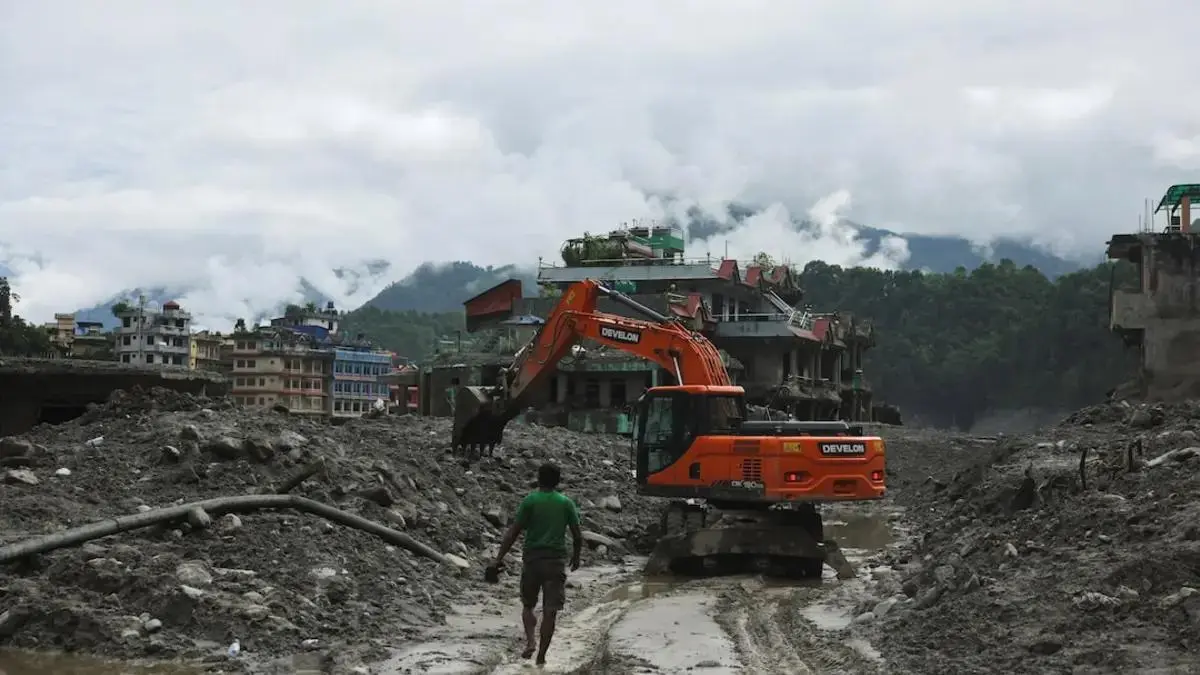
Trishuli, also in Nuwakot, has become one of the visible centres of the response. Excavators are clearing muddy routes as crews work around damaged hydropower infrastructure.
The recovery of bodies as teams reach new locations shows why the confirmed toll can rise even when the flood itself has passed. Some villages were isolated for days, and authorities are still establishing the scale of loss in each community.
International help arriving in Nepal
Prime Minister Shah says more than $42 million in aid has been received, with additional contributions expected.
India and China are directly supporting rescue and access operations. South Korea has also announced a 44-member emergency relief team following Nepal's request for assistance. The deployment includes foreign ministry and fire-agency personnel and is expected to remain for about ten days.
International assistance is particularly valuable when it brings specialist capabilities: urban search and rescue, bridge construction, helicopters, medical teams, satellite communications and equipment for operating in unstable tunnels.
Aid coordination matters as much as the total amount. Supplies must reach the most isolated communities, avoid duplication and support Nepal's own disaster-management system rather than creating parallel operations.
Power and communications begin to return
The restoration of electricity and communications in some areas is an important turning point.
Mobile service helps separated families share their location and allows local officials to report urgent needs. Power supports hospitals, water systems, cold storage and rescue equipment. It also reduces dependence on generators at a time when damaged roads make fuel deliveries difficult.
The national grid may still face longer-term pressure because hydropower is central to Nepal's energy system. Damage assessments will have to determine which plants can restart safely and which require extensive rebuilding.
Restoring generation too quickly could expose workers to unstable tunnels or slopes. The immediate priority remains rescue and site safety, followed by temporary electricity solutions and a phased return of permanent capacity.
What happens after the rescue phase?
Nepal will face a long recovery even after every accessible site has been searched.
Thousands of residents have lost homes, relatives and livelihoods. Roads, schools, health facilities, power stations and water systems will need repair. Families will require shelter and income support while communities decide whether it is safe to rebuild in the same locations.
The government will also face questions about disaster warnings, evacuation planning and the standards used to protect hydropower workers. Each damaged project can provide evidence about which tunnel designs, escape routes and communications systems performed well and which failed.
Long-term recovery should include better glacier and lake monitoring, stronger early-warning networks and clearer evacuation routes for downstream settlements. It may also require difficult decisions about where infrastructure should not be rebuilt.
What travellers should know
Foreign visitors should avoid flood-affected districts and follow instructions from Nepalese authorities. Conditions can change quickly when roads reopen or when unstable slopes move again.
Travellers already in the region should register with their embassy where possible, keep physical and digital copies of identification, and avoid attempting to cross damaged bridges or landslide zones without official clearance.
Anyone planning a Nepal trip should check current route closures and weather warnings before departure. The disaster is concentrated in affected Himalayan areas, but transport disruption can reach airports, bus routes and trekking supply chains elsewhere.
A disaster with consequences beyond Nepal
The floods illustrate a wider Himalayan challenge shared by Nepal, China, India, Bhutan and Pakistan. Glaciers and glacial lakes cross political boundaries, while rivers carry risk downstream across borders.
Regional data-sharing can provide earlier warnings, particularly when a lake or landslide develops on one side of a border and threatens communities on the other. Joint monitoring, satellite analysis and emergency communication protocols are therefore not optional climate projects; they are immediate public-safety tools.
For now, Nepal's rescuers are focused on the hundreds still stranded. Reopened roads and temporary bridges have created progress, but the continuing recovery of bodies underscores the scale of the tragedy and the urgency of reaching every remaining site.
Sources
- Reuters: Nepal rescuers reach remote areas and electricity is restored, September 1, 2026
- Reuters: South Korea to send a 44-member disaster relief team to Nepal, September 1, 2026
- Reuters: Rescuers battle floods and debris after Himalayan disaster, August 30, 2026
Thumbnail: An excavator clears a muddy path in Trishuli, Nepal, on September 1, 2026. Photo by Francis Mascarenhas/Reuters.