U.S. President Donald Trump and Chinese President Xi Jinping used their White House meeting to address the issues most capable of shaping relations between the world's two largest economies: trade, artificial intelligence, Taiwan and major international conflicts.
The September 24 talks came during Xi's state visit to the United States and less than half a year after the two leaders met in China. The rapid exchange of visits is notable, but the value of the summit will depend on whether broad commitments become durable policy.
What the two leaders discussed
China's official readout of the Trump-Xi talks said economic and trade teams had reached a new joint arrangement after another round of consultations. The readout did not publish every commercial detail, so the scope and implementation timetable require further official documentation.
Both leaders supported continuing dialogue on AI, according to the Chinese account. Xi argued that the technology should remain under human control and that the countries could discuss both its risks and benefits. Trump also backed continued AI dialogue and cooperation.
The two presidents discussed the Middle East, Ukraine and the Korean Peninsula. They also agreed to support each other as hosts of the 2026 APEC Economic Leaders' Meeting and the G20 Summit, the readout said.
Taiwan remained a point of difference. Xi repeated China's position on territorial integrity and urged the United States to oppose Taiwan independence. The public account did not suggest that the long-standing disagreement had been resolved.
Why trade is the immediate test
Trade agreements matter only when businesses know which tariffs, export rules and market-access conditions will apply. A broad announcement can improve sentiment, but manufacturers and investors need written measures, dates and enforcement mechanisms before changing supply chains.
The two economies remain deeply connected through consumer goods, industrial components, agriculture, finance and technology. That means a policy change can quickly affect prices and planning outside both countries. European exporters, Asian manufacturers, commodity producers and global shipping companies all watch U.S.-China talks for signs of stability or renewed friction.
The meeting builds on the earlier U.S.-China trade truce and plans for Xi's 2026 visit. This summit is the next checkpoint, not the conclusion of the process.
AI has become a diplomatic issue
Artificial intelligence was once mostly a research and business subject. It is now part of high-level diplomacy because access to advanced chips, data centres and models has national-security and economic consequences.
Dialogue could be useful in areas where neither country benefits from uncontrolled risk, such as the misuse of autonomous systems, dangerous model behaviour or accidents caused by poor communication. At the same time, both governments view AI capability as strategically important, so cooperation will exist alongside competition.
The leaders' public support for discussion is therefore a starting point. Progress would require technical meetings, defined subjects and a way to manage incidents. It would also need to survive periods of tension in trade or security.
The symbolism of the state visit
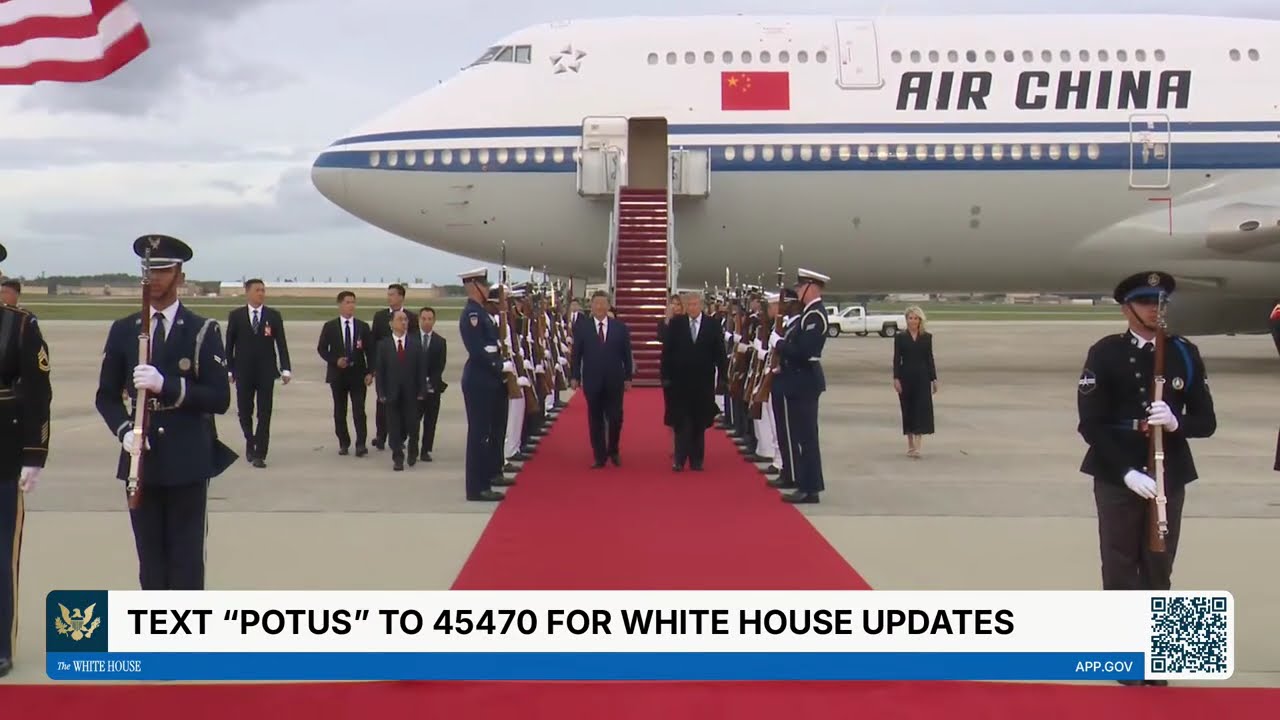
Xi and his wife, Peng Liyuan, were welcomed by Trump and First Lady Melania Trump at the White House. The arrival included national anthems, remarks and a military review. The official photograph used with this article comes from China's Foreign Ministry coverage of that ceremony and shows all four at the White House.
Ceremony can signal that both sides want to stabilize ties, but it should not be confused with a policy outcome. The substantive measures will appear in regulations, joint documents and follow-up meetings.
That distinction is especially important when each government publishes its own account. Official readouts are authoritative descriptions of a government's position, but readers should note which side is making a claim and look for matching details in documents from both governments.
What to watch after the summit
The first item is the promised trade arrangement. Markets will look for product coverage, tariff levels, purchasing commitments and implementation dates. The second is whether an AI dialogue receives a formal structure. The third is crisis management around Taiwan and other security issues.
There is also a broader political test: can the two governments keep cooperation moving when new disagreements emerge? A summit can open a channel, but consistent working-level contact is what prevents that channel from closing.
For the global economy, even limited predictability would be valuable. For the leaders, the challenge is turning carefully worded summit language into rules and behaviour that companies, allies and citizens can actually observe.
Frequently asked questions
When did Trump and Xi meet at the White House?
They held talks on September 24, 2026, during Xi Jinping's state visit to the United States.
What subjects were discussed?
The official Chinese readout listed trade, artificial intelligence, Taiwan, the Middle East, Ukraine and the Korean Peninsula.
Did the summit produce a full trade deal?
The Chinese readout said the negotiating teams reached a new joint arrangement, but it did not publish all terms. Further official details are needed to evaluate its scope.