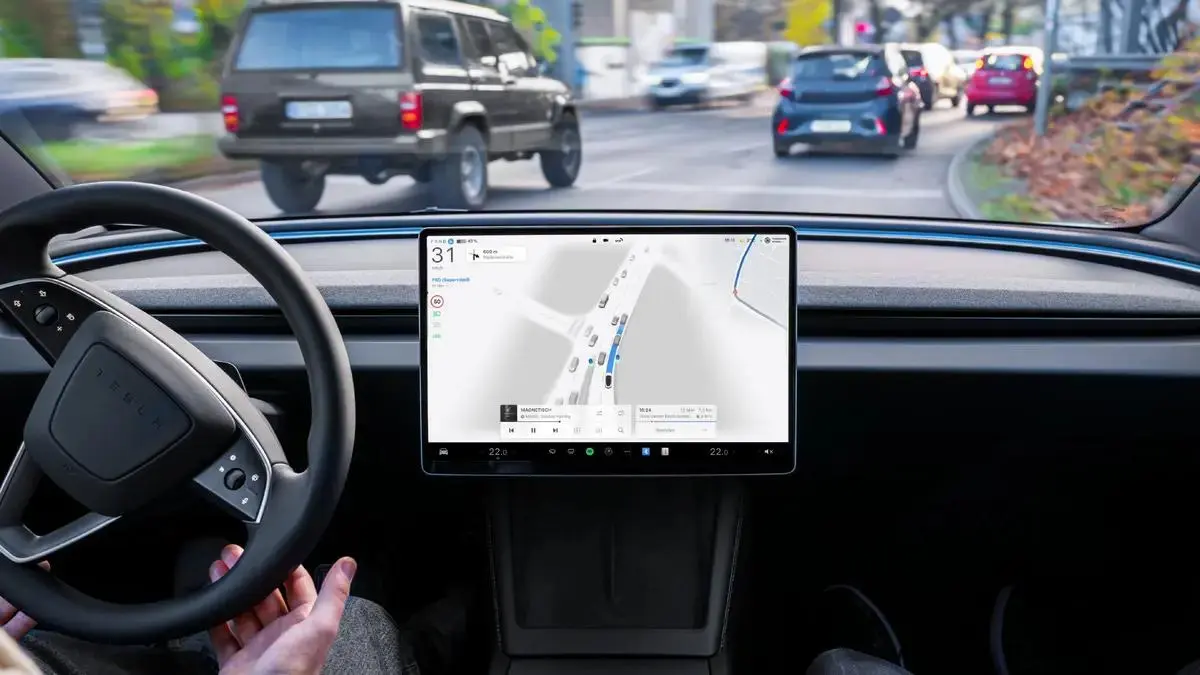
Qwen-Drive 1.0 is a compact vision-language model designed to interpret driving scenes and propose how a vehicle should move through them. Its developers present it as an early foundation model for autonomous-driving research rather than a finished self-driving system.
The distinction matters. A model can identify road users, answer questions about a scene and generate a possible trajectory without being ready to control a real vehicle safely. Production autonomy also requires sensors, mapping, vehicle control, redundancy, extensive validation and compliance with local regulation.
What is Qwen-Drive 1.0?
Qwen-Drive 1.0 is built on the Qwen3.5-4B vision-language family and trained for road-scene tasks. The published model family includes a roughly five-billion-parameter checkpoint distributed through Hugging Face.
It is intended to combine capabilities that are often evaluated separately:
- visual understanding of traffic scenes;
- recognition of vehicles, pedestrians, lanes and signals;
- spatial and causal reasoning;
- question answering about driving situations;
- generation of a future driving trajectory.
Instead of treating perception and planning as unrelated problems, the project explores whether a shared model can reason across both.
How does the model read a road scene?
A vision-language model receives visual information together with a text instruction or structured prompt. In a driving context, the image may show lane markings, vehicles, traffic lights, cyclists or pedestrians.
The model can then be asked questions such as which object creates the greatest immediate risk, why a vehicle ahead is slowing or what manoeuvre is appropriate. Training examples connect pixels with language, spatial relationships and driving decisions.
That approach differs from a traditional pipeline in which separate modules detect objects, estimate depth, predict motion and plan a path. A foundation-model approach tries to share representations across tasks, although practical systems may still combine both methods.
What makes Qwen-Drive different?
The main attraction is its relatively compact scale. Smaller models may be easier to study, fine-tune and eventually run closer to the vehicle than extremely large cloud models.
The developers report results across driving question-answering, spatial estimation, safety-oriented benchmarks and general visual understanding. Their published comparisons suggest the specialised training improves road-scene reasoning while preserving much of the base model's broader vision-language capability.
Benchmark tables are useful, but they should not be mistaken for proof of road readiness. Results can depend on datasets, prompts, decoding settings and evaluation methods. Real streets contain unusual weather, damaged markings, emergency vehicles, unpredictable human behaviour and sensor failures that curated benchmarks cannot fully reproduce.
Can Qwen-Drive control a car?
The public model should be understood as a research component, not a consumer autopilot.
Producing a trajectory means predicting a plausible future path in a defined representation. Turning that prediction into steering, acceleration and braking commands requires a validated control system. A road vehicle must also monitor hardware health, respond safely when confidence falls and meet strict latency requirements.
Even a model that answers scene questions accurately can make rare but serious mistakes. Autonomous-driving safety is shaped by those edge cases, not only average benchmark performance.
Why vision-language reasoning matters for autonomous driving
Language gives researchers a way to inspect what a model appears to understand. If a system recommends slowing down, it may also explain that a pedestrian is approaching a crossing or that a parked vehicle is blocking visibility.
Explanations do not guarantee that the reasoning is correct, but they can help engineers analyse failures and create targeted tests. Natural-language interfaces may also make it easier to label data, generate scenarios and communicate with passengers.
The broader goal is a system that does more than detect objects. It should understand relationships: a ball rolling into the road may imply that a child could follow; an open car door changes the safe passing distance; a green light does not eliminate the need to yield to an obstruction.
What are the limitations?
Several limitations remain important:
- Benchmark performance is not deployment approval. Closed-course and public-dataset results cannot establish safety on every road.
- Visual models can be confidently wrong. Poor lighting, occlusion or unfamiliar signs may produce incorrect interpretations.
- Trajectory generation is only one layer. Reliable localisation, sensor fusion, control and fallback systems are still required.
- Regional driving rules vary. Signs, lane behaviour and road design differ across countries.
- Compute still matters. A compact model is easier to deploy than a giant one, but real-time multi-camera processing remains demanding.
Researchers also need transparent evaluation against rare hazards and adversarial conditions. A model that performs well during ordinary daytime driving may behave differently in heavy rain, glare, construction zones or chaotic mixed traffic.
Why the release matters
Qwen-Drive 1.0 reflects a wider shift in autonomous-driving research toward general models that can connect perception, language and action. Open model weights and published evaluation details allow independent teams to test claims, identify weaknesses and build specialised experiments.
Its importance is therefore less about an immediate self-driving product and more about accessibility. A compact public model gives universities and smaller laboratories a starting point for work that previously required much larger proprietary systems.
Readers can follow additional AI releases and practical technology explainers in our Technology section and broader how-it-works coverage in Explainers.