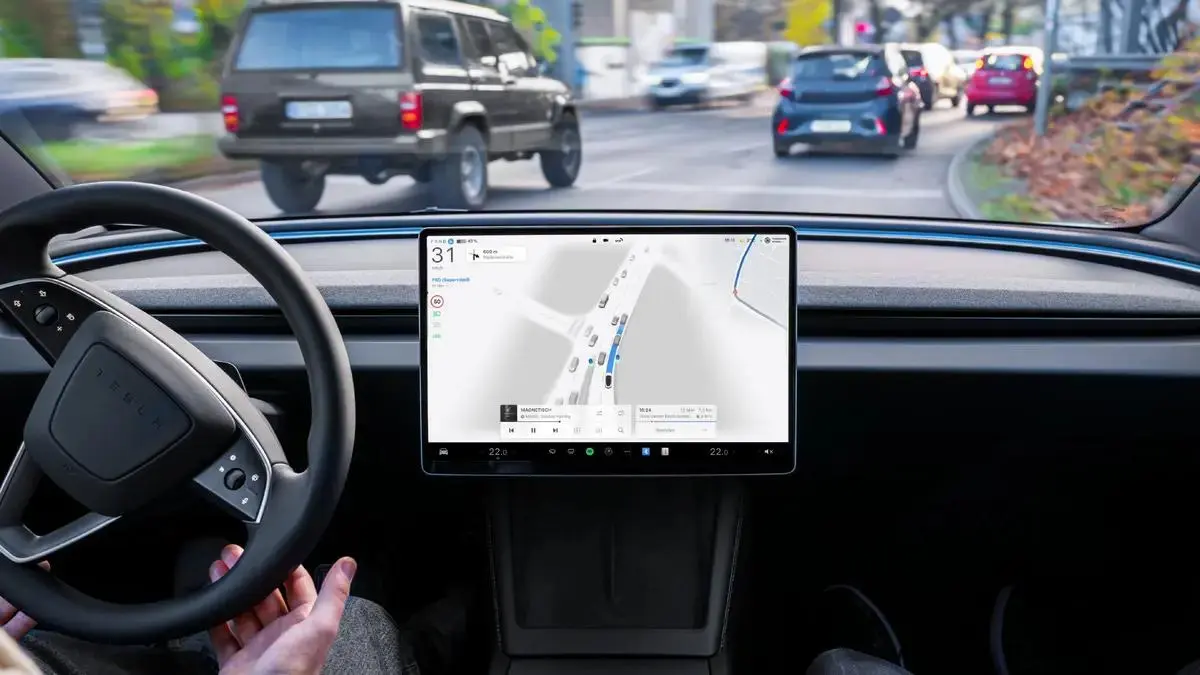
Tesla has released new European safety data claiming its Full Self-Driving Supervised system recorded 4.1 times fewer collisions than manually driven Tesla vehicles, as the company campaigns for approval across the European Union.
The figures cover more than 100 million kilometres driven between April and August 2026 in the Netherlands, Belgium, Denmark, Estonia and Lithuania. Those countries have granted provisional permission for the supervised system.
A wider EU vote could take place as early as October 6.
What Tesla's data says
Tesla reported three highway collisions and nine non-highway collisions involving supervised FSD during the measured period.
The company compared those results with 137 highway collisions and 490 non-highway collisions involving manually driven Teslas across the same five countries.
After adjusting for distance driven, Tesla says the automated system produced a collision rate 4.1 times lower.
The company has launched an open safety dashboard, arguing that public data should give regulators and drivers more confidence.
Why the comparison remains disputed
A lower raw collision rate does not automatically prove that software is safer in every situation. FSD use may be concentrated on roads, weather conditions and journeys where drivers feel comfortable activating it.
Manual driving may include more difficult conditions, parking areas or inexperienced drivers. The vehicles using FSD may also be newer and equipped with different hardware.
Independent analysts need detailed information about crash severity, road type, driver behaviour and how often the system disengaged before an incident.
Tesla's dashboard is a step toward transparency, but experts will examine whether its methodology allows a fair comparison.
What “supervised” means
Despite the Full Self-Driving name, the European system requires an attentive driver who remains responsible for the vehicle. It can steer, accelerate and brake, but the driver must be ready to intervene.
This distinction is legally important. Approval would not authorize fully driverless private Teslas across Europe.
Regulators also worry that marketing may lead users to overestimate the technology. Monitoring driver attention and limiting misuse are therefore part of the safety debate.
How the EU vote works
EU-wide approval would require support from at least 15 of the bloc's 27 member states representing at least 65 percent of the EU population.
The Netherlands has been a leading supporter after granting provisional approval. Other countries remain cautious, and Sweden has raised concerns about the software's handling of speed limits.
If the vote succeeds, Tesla could deploy the system much more broadly without negotiating a completely separate approval in every national market.
Why Europe matters to Tesla
Tesla faces intense competition and uneven sales in Europe. FSD is central to the company's argument that its vehicles can generate high-margin software revenue after purchase.
Approval could make European models more attractive and create recurring subscription income. Failure or delay would weaken a key part of Tesla's growth story.
The vote also has implications for other automakers. A common standard for supervised automated driving could accelerate competing systems from European, American and Chinese manufacturers.
Questions regulators must answer
Officials must decide whether the evidence covers enough kilometres, countries and difficult conditions. They also need clear rules for software updates, crash reporting and responsibility when a driver fails to intervene.
Commercial confidentiality has limited publication of some testing data, prompting criticism that the public cannot independently evaluate the evidence supporting approval.
Tesla's newly released numbers strengthen its political campaign, but they do not end the technical debate. The October decision will depend on whether European governments believe the system's measured benefits outweigh uncertainty about how millions of ordinary drivers will use it.
