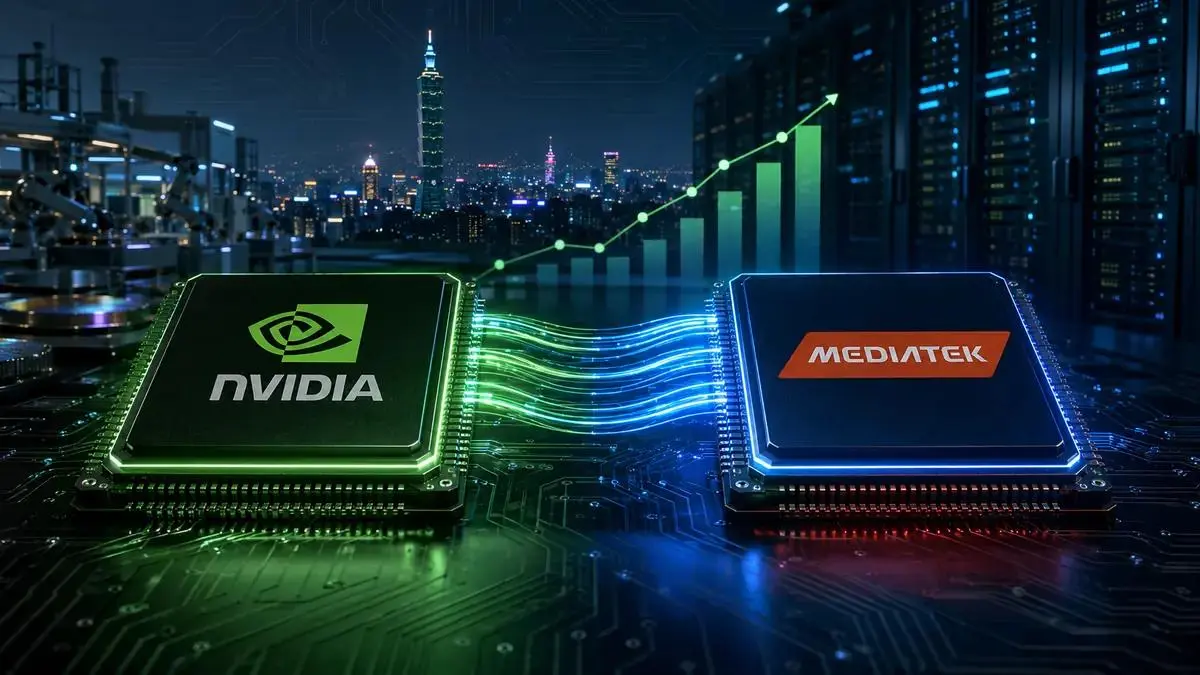
Nvidia is investing $3.5 billion in MediaTek as the two semiconductor companies deepen a partnership that now stretches from data-center infrastructure to personal computers and AI-powered vehicles.
The investment will be made through convertible bonds issued by MediaTek. Alongside the financial deal, the companies announced a broader multigenerational collaboration focused on custom AI infrastructure, local AI computing and automotive platforms.
For Nvidia, the agreement extends its technology beyond its own processors and gives customers another route to build specialized AI chips that remain connected to Nvidia's wider computing ecosystem. For MediaTek, it opens a larger role in the rapidly growing market for data-center silicon while building on the company's established strength in power-efficient chip design.
What Nvidia and MediaTek announced
The expanded partnership covers three main areas:
- Custom AI infrastructure built around Nvidia's NVLink Fusion platform
- Continued development of chips for Nvidia RTX Spark and DGX Spark systems
- New generations of automotive platforms combining MediaTek and Nvidia technology
The headline figure is Nvidia's $3.5 billion purchase of MediaTek convertible bonds. Convertible bonds begin as debt but can later be converted into shares under agreed conditions, giving Nvidia financial exposure to MediaTek while the companies work together on future products.
The deal was announced on August 31, 2026. Nvidia described it as an effort to create AI platforms spanning the edge, local devices and cloud-scale infrastructure.
Why NVLink Fusion matters to the deal
One of the most important parts of the agreement is MediaTek's adoption of Nvidia NVLink Fusion.
Large AI systems do not rely on a single processor. They combine accelerators, central processors, memory and networking across entire server racks. The speed at which those components communicate can determine how efficiently a system trains or runs an AI model.
NVLink is Nvidia's high-speed interconnect technology for connecting processors inside these systems. NVLink Fusion is designed to let companies create custom processors, often described as XPUs, that can work within Nvidia's rack-scale architecture.
MediaTek will use the platform to help hyperscalers, cloud providers and AI developers design specialized chips without starting every part of the system from scratch. The companies say this prevalidated approach can reduce engineering complexity and shorten development timelines.
That is strategically important for Nvidia. Major cloud companies increasingly want custom silicon optimized for their own workloads, but Nvidia still wants those chips connected to its networking, software and accelerated-computing platforms. The MediaTek partnership gives customers more customization while keeping Nvidia's technology at the center of the system.
The partnership goes beyond data centers
Nvidia and MediaTek are also extending their work on local AI computing.
The companies will continue jointly developing chips for Nvidia RTX Spark and DGX Spark products. These systems combine Nvidia graphics technology with MediaTek's system-on-chip expertise and are intended to run demanding AI workloads closer to users, including on PCs, compact workstations and developer systems.
Local AI has become a major focus across the technology industry. Running more workloads on a device can reduce dependence on cloud services, improve response times and help keep sensitive information on the user's own hardware. It can also allow developers and businesses to use AI tools when a constant high-speed internet connection is unavailable.
MediaTek's experience building highly integrated, power-efficient chips makes it a useful partner as Nvidia tries to bring its AI platform into smaller and more energy-conscious devices.
Nvidia and MediaTek are expanding their automotive plans
The third part of the agreement covers AI-defined vehicles.
MediaTek's Dimensity Auto platforms already combine connectivity, entertainment and computing features for vehicles. Under the expanded collaboration, future generations will integrate Nvidia AI and RTX graphics technology and can work alongside Nvidia DRIVE AGX systems.
Modern vehicles increasingly depend on software for driver assistance, infotainment, voice interaction and in-cabin experiences. Automakers also want platforms that can receive new features through software updates over the life of a vehicle.
By combining MediaTek's automotive chip platforms with Nvidia's AI and graphics capabilities, the companies are positioning themselves to supply more of that computing stack rather than focusing on a single component.
Why Nvidia is investing in MediaTek now
Nvidia has become the dominant supplier of accelerators used to train and operate generative AI systems, but competition is evolving. Cloud providers and large technology companies are designing more of their own chips to control costs, power use and performance.
Instead of treating every custom processor as a direct threat, Nvidia is creating ways for those chips to connect to its systems. NVLink Fusion supports that approach, and MediaTek brings expertise in custom silicon, advanced packaging, connectivity and system-on-chip design.
The investment also strengthens an existing relationship. Nvidia and MediaTek have already worked together on computing and automotive products. The new agreement turns that cooperation into a longer-term partnership covering multiple generations of hardware.
What the deal means for the AI chip market
The announcement shows how the AI hardware market is moving beyond a simple contest between individual chips.
Customers now evaluate entire systems: processors, memory, networking, cooling, software and the ease of deploying them at scale. A company may want a custom accelerator but still prefer a proven architecture for connecting hundreds or thousands of processors.
Nvidia's strategy is to make its ecosystem useful even when another company designs part of the silicon. MediaTek, meanwhile, gains a path into larger AI infrastructure projects while retaining opportunities in PCs and vehicles.
The products created under the expanded partnership will arrive over multiple generations, so the full commercial impact will take time to emerge. Still, the $3.5 billion investment makes clear that both companies see the relationship as more than a short-term product collaboration.
The bottom line
Nvidia's $3.5 billion investment in MediaTek is tied to a much wider technology agreement. MediaTek will support custom AI infrastructure through NVLink Fusion, continue developing chips for Nvidia's local AI systems and expand its work on AI-powered automotive platforms.
The deal gives MediaTek a stronger position in data-center AI and gives Nvidia another way to keep its technology embedded in custom computing systems. As cloud companies demand more specialized silicon, partnerships like this could become an increasingly important part of how the AI chip market develops.