Alibaba has placed a new piece on the global AI hardware board. At its 2026 Apsara Conference, the company introduced the Zhenwu V900 accelerator and confirmed that Qwen 4 is in training, tying its next model generation to a wider plan spanning chips, cloud infrastructure and AI services.
The announcement matters beyond China. Demand for computing power is still shaping data-centre investment, model economics and access to advanced AI worldwide. Alibaba is arguing that the winning platform will not be a single model or processor, but a stack in which both are designed to work together.
What Alibaba announced
According to Alibaba Cloud's official announcement, the Zhenwu V900 has 216GB of GPU memory and inter-chip bandwidth of 1,200GB per second. Alibaba says it delivers three times the performance of its earlier Zhenwu M890 while consuming less power per unit of work.
Mass production and commercial availability are planned for the first quarter of 2027. That timing is important: this is a roadmap, not a chip customers can broadly order today. Real-world performance, software compatibility, pricing and supply will become clearer only when production hardware reaches users.
Alibaba also said the Zhenwu product line already serves more than 650 customers across sectors including internet services, finance, manufacturing and scientific research. Its larger infrastructure plan includes supernode clusters that could scale to 500,000 accelerator cards.
Qwen 4 is in training
The software side of the announcement is just as significant. Alibaba confirmed that Qwen 4 is being trained, while future Qwen 4.5 and Qwen 5 systems could range from five trillion to ten trillion parameters. Parameter count is not a direct measure of quality, but the target reveals the scale of infrastructure Alibaba expects to operate.
The company is positioning Qwen as an open model family that can support developers, enterprises and AI agents. Its pitch is that model research, chip design and cloud deployment can advance together, reducing the friction of moving from an experiment to a production service.
That approach resembles the broader industry's push toward vertically integrated AI. Cloud providers increasingly want control over networking, accelerators, model tooling and inference services because bottlenecks in any one layer can raise costs across the system.
Why the Zhenwu V900 could matter globally
More credible accelerator options could help companies diversify their infrastructure. AI developers currently face a mix of high demand, long procurement cycles and rising power requirements. A new supplier does not automatically solve those problems, but it may expand capacity in markets where Alibaba Cloud already operates.
The 216GB memory figure is especially relevant for large-model inference and training, where memory can determine how a workload is distributed across multiple devices. Higher inter-chip bandwidth can also reduce delays when accelerators need to exchange data inside a cluster.
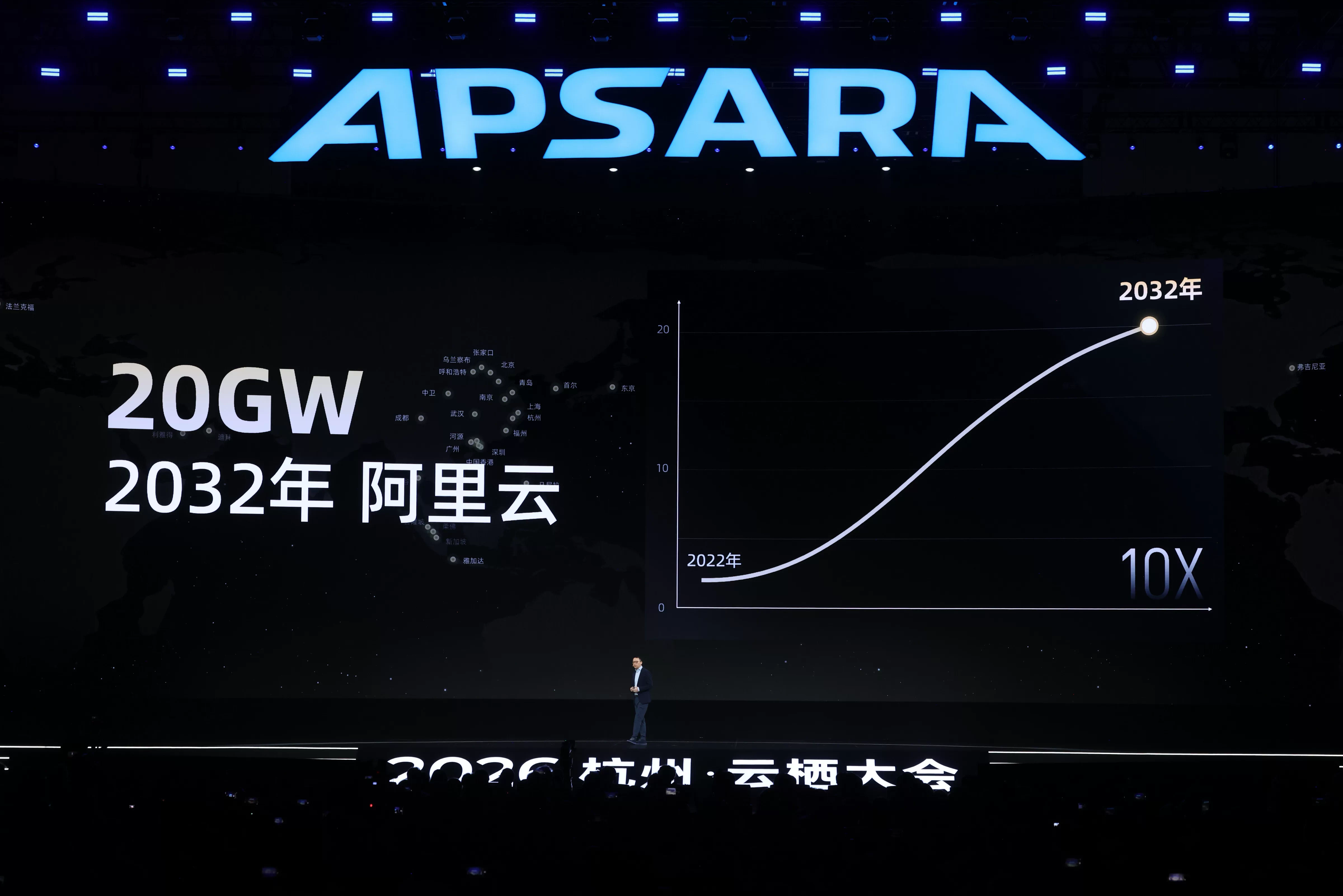
Alibaba says it is targeting 20 gigawatts of cloud data-centre capacity by 2032. That ambition also raises practical questions about electricity, cooling and regional infrastructure. The next phase of AI competition will be measured not only by benchmark scores, but by how efficiently companies can deliver useful computing at scale.
What remains unproven
The V900 specifications come from Alibaba and have not yet been tested across a broad set of independent workloads. Buyers will want evidence about reliability, developer tools, total operating cost and performance across training and inference—not just headline throughput.
The same caution applies to the Qwen roadmap. Training a model at multi-trillion-parameter scale is different from making it dependable, affordable and easy to deploy. Details about architecture, release terms and production availability have not all been disclosed.
Still, the announcement is a clear signal that Alibaba wants to compete across the entire AI supply chain. It also arrives as companies experiment with new consumer hardware, including Meta's Muse and Charm AI devices, showing how quickly model and chip advances are moving into products.
What to watch next
The first checkpoint is Q1 2027, when Alibaba expects commercial Zhenwu V900 availability. Independent benchmarks, cloud pricing and customer case studies will determine whether its claimed efficiency translates into meaningful savings.
Developers should also watch how Qwen 4 is released and which tools support it. If Alibaba can connect competitive models with abundant, cost-efficient hardware, the V900 could become more than a domestic alternative. If software or supply falls short, the ambitious specifications may remain a conference promise.
Frequently asked questions
What is the Alibaba Zhenwu V900?
It is Alibaba's newly announced AI accelerator, designed for large-scale model training and inference. The company lists 216GB of memory and 1,200GB/s inter-chip bandwidth.
When will the Zhenwu V900 be available?
Alibaba plans mass production and commercial release in the first quarter of 2027.
Has Alibaba released Qwen 4?
No. Alibaba said Qwen 4 is in training. A public release date and full technical details were not announced.