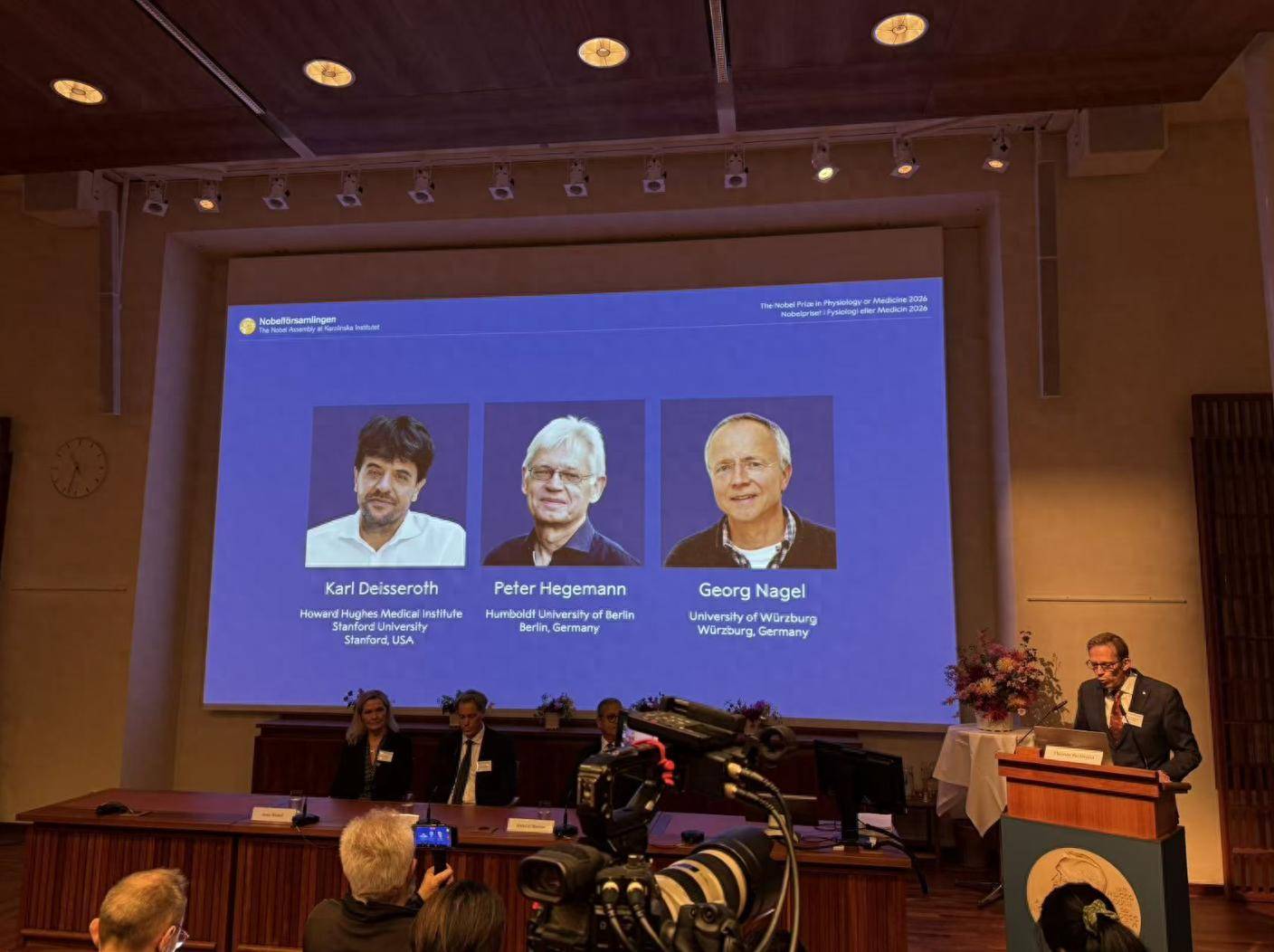
The 2026 Nobel Prize in Physiology or Medicine has gone to Karl Deisseroth, Peter Hegemann and Georg Nagel for discoveries concerning light-gated ion channels and optogenetics. In plain language, optogenetics gives researchers a way to control selected nerve cells with light. It has changed how scientists investigate brain circuits by helping them test what particular groups of neurons do, rather than simply observing activity after the fact.
The Nobel Assembly at Karolinska Institutet said the method can switch the activity of individual nerve cells on or off in a living brain. The award recognises the research that made this precise approach possible; it does not mean that optogenetics is already a routine treatment for brain disorders. Most clinical applications remain experimental.
What is optogenetics?
Optogenetics combines genetics and optics. Researchers introduce a light-sensitive protein into a chosen type of cell. When light of the right wavelength reaches that protein, it changes how charged particles move across the cell membrane. That can make a neuron more or less likely to send an electrical signal.
The key advantage is precision. Electrical stimulation can activate nearby cells as well as the intended target, while a drug can spread through tissue and affect many cells. Optogenetics can be designed to influence selected cell populations and can operate quickly. Scientists can then observe how a behaviour or brain signal changes when that circuit is activated or inhibited.
How did an algae protein lead to a brain tool?
The story began with single-celled algae that respond to light. Hegemann studied how the organism reacts to illumination, and Nagel helped test the light-sensitive proteins involved. Their work identified channelrhodopsins, proteins that allow ions to cross cell membranes when activated by light. Deisseroth and collaborators then adapted these proteins for use in neurons, demonstrating that the activity of nerve cells could be controlled with light.
The breakthrough did not come from one experiment alone. It required molecular biology to target the proteins to selected cells, engineering to deliver light into tissue and careful experiments to show that changing a circuit caused a measurable effect. That combination helped make optogenetics a widely used research method in neuroscience labs.
What can scientists learn with it?
Researchers use optogenetics to study circuits linked to movement, sleep, memory, emotion and motivation. If a specific set of neurons is activated and an animal’s behaviour changes, scientists can investigate whether that circuit contributes to the behaviour. If silencing it removes a response, that can add evidence about the circuit’s role. The method helps test causal questions that are difficult to answer from brain scans or recordings alone.
This can improve basic understanding of conditions such as epilepsy, Parkinson’s disease, addiction and some psychiatric disorders. It does not by itself diagnose or cure them. Researchers first use models to map the biology and test hypotheses; separate evidence is needed before a treatment can be considered safe and effective in people.
Is optogenetics a treatment for blindness or mental illness?
Not as a general approved treatment today. Some research explores optogenetic approaches for restoring limited visual responses in people with severe retinal disease, but these are specialised clinical investigations with strict eligibility and follow-up. That is different from saying the Nobel-winning method can broadly cure blindness, depression or dementia.
There are also practical limits. Delivering genes to the right cells and getting light into tissue safely are difficult, especially deep inside the human brain. The technique is currently most valuable as a research tool. Any future clinical use would require evidence from controlled studies, regulatory review and long-term monitoring.
Why the Nobel recognition matters
The prize highlights how a basic question about a light-responsive protein in algae eventually produced a tool used to study living neural circuits. It also reflects the collaborative nature of science: foundational discoveries, engineering changes and biological experiments all contributed to the method. The immediate impact is stronger research capability, while possible medical applications need to be assessed over time rather than promised on the day of the award.
Frequently asked questions
Who won the 2026 Nobel Prize in Physiology or Medicine? Karl Deisseroth, Peter Hegemann and Georg Nagel.
What does optogenetics do? It uses light-sensitive proteins to influence selected cells, including neurons, so researchers can study how those cells affect a circuit or behaviour.
Is it already a standard treatment? No. It is primarily a research method; some clinical applications are under investigation.
Where is the official award information? See the Nobel Prize announcement and its popular information explainer.
Sources: Nobel Prize 2026 award announcement; Nobel Prize popular information; Stanford Medicine overview of optogenetics; photo of the 2026 announcement, Sohu.