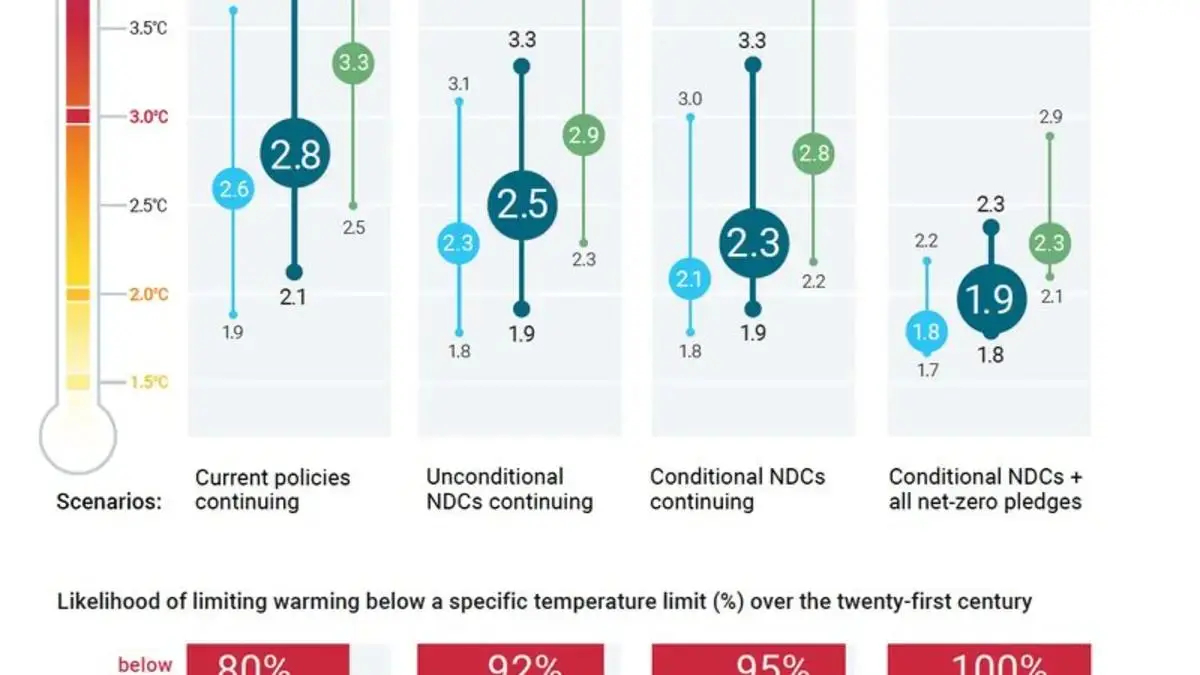
The world is expected to exceed 1.5°C of global warming within the next few years, according to a new United Nations Environment Programme report. The warning does not mean climate action has become pointless. It means the original path to the Paris Agreement's safest limit is closing and every additional fraction of warming now carries greater consequences.
UNEP says temperatures could reach at least 1.8°C even under an optimistic pathway, while current policies point closer to 2.3°C. Returning below 1.5°C later remains technically possible, but would require rapid emissions cuts and large-scale removal of carbon dioxide from the atmosphere.
What is the 1.5°C limit?
The number compares average global temperature with the pre-industrial period, usually defined using the late nineteenth century. It is not a forecast for the temperature on a particular day or in a single country.
Governments agreed in Paris to pursue efforts to limit warming to 1.5°C because risks rise substantially beyond that level. Extreme heat, heavy rainfall, drought, sea-level rise and ecosystem loss all become more severe as the planet warms.
The threshold is not a magical cliff where safety exists at 1.49°C and disaster begins at 1.51°C. It is a risk marker. Every tenth of a degree avoided reduces harm.
What does “overshoot” mean?
Overshoot describes a period when warming rises above a target before being brought back down later. A 1.5°C overshoot pathway might peak near 1.7°C or 1.8°C and then return below 1.5°C by the end of the century.
Bringing temperatures down requires the world to reach net-zero carbon dioxide emissions and then remove more CO2 than it releases.
Natural methods include restoring forests, wetlands and soils. Technological approaches include capturing carbon directly from air and storing it underground. None currently operates at the global scale required to substitute for immediate emissions reductions.
Why temporary overshoot still causes permanent damage
Some climate impacts can improve when temperatures fall, but others cannot be fully reversed. Species may become extinct, glaciers can cross irreversible thresholds and coral reefs may be destroyed during the hotter decades.
Sea levels respond slowly and can continue rising for centuries because oceans and ice sheets retain heat. Communities forced to leave coastlines may not simply return after the global average declines.
That is why scientists reject the idea that humanity can safely emit now and clean up later. Overshoot creates real damage during the period above 1.5°C and relies on uncertain future carbon-removal capacity.
Why 1.8°C is different from 2.3°C
Climate debate can make small decimal differences sound unimportant. At a planetary scale, they affect the frequency and intensity of events experienced by billions of people.
At higher warming levels, dangerous heat becomes more common, crop failures can occur simultaneously across regions and extreme rainfall places greater stress on cities. Low-lying islands face higher seas and stronger pressure on freshwater supplies.
Avoiding 0.5°C of additional warming can therefore prevent enormous economic losses and reduce the number of people exposed to lethal conditions.
What must happen now?
The first priority remains cutting fossil-fuel emissions. Expanding clean electricity, improving efficiency, electrifying transport and reducing methane can slow the rate of warming.
Countries must also prepare for impacts that can no longer be avoided. Adaptation includes heat-resistant infrastructure, early-warning systems, flood protection, water management and support for farmers facing changing seasons.
Carbon removal will be necessary for residual emissions from sectors that are difficult to eliminate completely. It should complement emissions cuts rather than justify delaying them.
Is the Paris Agreement dead?
The agreement remains the main global framework for national climate commitments. Missing the 1.5°C pathway weakens confidence, but it does not remove the value of its temperature goals.
If the world cannot hold warming to 1.5°C without overshoot, the next objective is to minimize the peak and return below it as quickly as possible. Abandoning action could move the world toward far higher temperatures.
Climate targets work like limits on damage, not pass-or-fail exams. Failure to achieve the safest outcome is a reason to accelerate action, not a reason to accept every worse outcome.
The clearest takeaway
The UNEP warning is severe because time has been lost. Emissions remain high, existing policies are insufficient and future carbon removal is uncertain.
But the report's message is not that all outcomes are equal. A world that peaks at 1.8°C is safer than one reaching 2.3°C, and both are far safer than uncontrolled warming beyond them.
The 1.5°C overshoot changes the challenge. Humanity must cut emissions fast enough to limit how far temperatures rise, adapt to damage already arriving and build credible ways to remove carbon without treating future technology as an excuse for present delay.
Sources: Reuters summary of the UNEP report, UN climate information.
