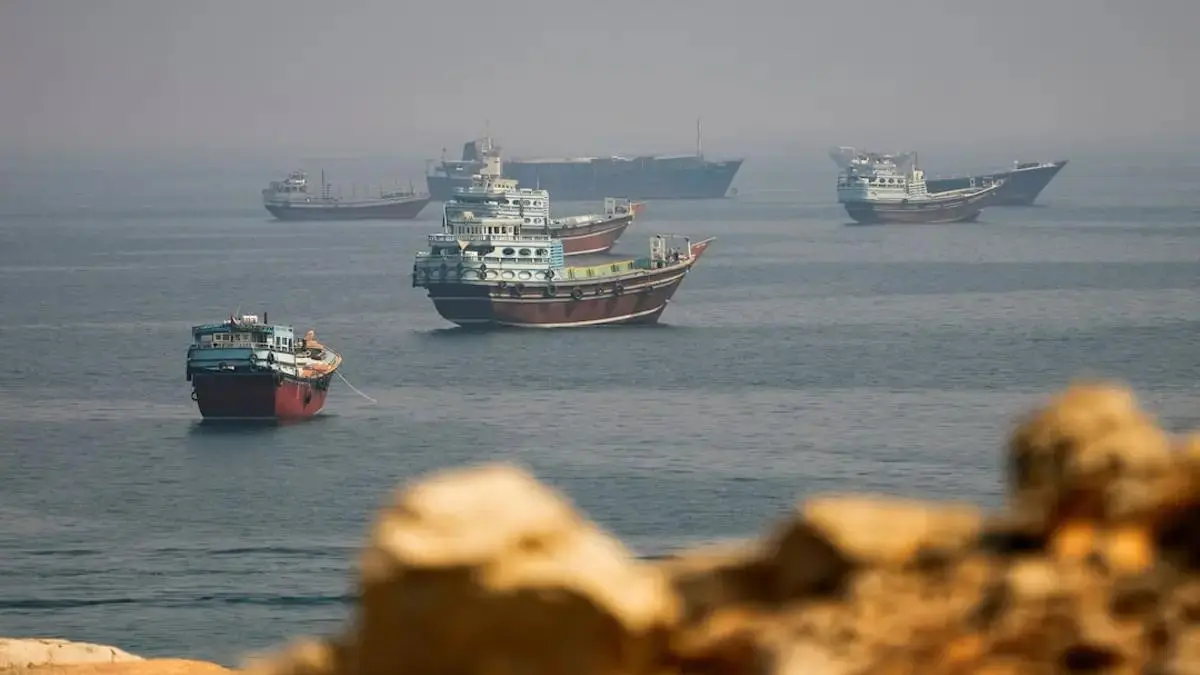
Iran has gone roughly seven weeks without sending meaningful fresh crude exports through the Strait of Hormuz, as a US naval blockade achieves what years of financial sanctions could not: physically preventing tankers from carrying new Iranian oil to China.
Data cited by Reuters from Kpler and Vortexa shows Iranian crude and condensate loadings falling to about 220,000-255,000 barrels per day in August. That compares with roughly 740,000 bpd in July and about 2 million bpd in March.
The decline does not mean every barrel of Iranian oil has disappeared from the market. Iran can still sell crude stored on tankers outside the blockade. The problem is that this floating inventory cannot be replenished while loaded ships remain trapped inside the strait and empty vessels cannot return.
Sanctions versus a naval blockade
Sanctions use financial and legal pressure. They can restrict banking, insurance, shipping services and business with designated companies.
Iran previously worked around sanctions through discounted sales, ship-to-ship transfers, renamed vessels and a shadow fleet. Some oil continued moving even during maximum-pressure campaigns.
A naval blockade operates differently. US Navy vessels vet ships travelling to and from Iranian ports in a zone between the Gulf of Oman and Arabian Sea. The physical barrier makes evasion harder because a tanker still needs to pass through monitored water.
Kpler, Vortexa and TankerTrackers.com told Reuters that no Iranian crude cargo had successfully crossed Hormuz for China since the blockade was reinstated on July 14.
Why China is central
China is Iran's only major remaining crude customer. Iranian oil has been attractive to some Chinese buyers because it is sold at a discount.
The blockade does not immediately eliminate Chinese purchases. Cargoes already stored in Asian waters can still be delivered. Traders said September and October barrels remained on offer.
The inventory is finite, however. Every delivery reduces the pool outside the blockade, while no fresh oil replaces it.
That creates a delayed squeeze: imports may continue briefly even though the export route has effectively stopped.
The numbers behind the squeeze
Reuters reported several important estimates:
- August Iranian loadings: 220,000-255,000 bpd.
- July loadings: About 740,000 bpd.
- March loadings: About 2 million bpd.
- Tankers inside the strait: 29 carrying 36.11 million barrels.
- Iranian crude afloat west of the blockade line: 41.7 million barrels on August 26.
- Total Iranian crude afloat: 107 million barrels, down from 135 million.
- Sanctioned tankers waiting empty off Sri Lanka: 27.
Reuters said it could not independently verify every ship count, so these figures should be treated as tracking estimates rather than a complete official inventory.
Why empty tankers matter
Oil trading needs a loop. A tanker loads crude, delivers it and returns for another cargo.
The blockade breaks that loop. Loaded vessels inside Hormuz cannot leave normally. Tankers that delivered oil to Asia cannot return to Iranian ports. Ships accumulate on both sides of the restriction in the wrong condition and location.
This is why a country can have oil, customers and available ships but still fail to sustain exports.
Impact on Iran's economy
Oil supplies much of Iran's hard-currency income. A prolonged export collapse reduces the dollars and other currencies available for imports, debt payments and exchange-rate support.
If government revenue falls sharply, authorities may cut spending, draw down reserves or create more local currency. Printing money risks accelerating inflation.
The International Monetary Fund estimates Iran's inflation could approach 70% in 2026, according to Reuters. The blockade therefore intensifies pressure already visible in prices and the exchange rate.
Iran's central bank says the country has sufficient reserves and has offered to inject funds into the currency market. The duration of the blockade will determine how credible that defence remains.
Does the blockade cover Iran's whole coast?
No. Reuters reports that the US operation does not extend across the entire Iranian coastline. It is positioned farther south, where ships approaching and leaving Iranian ports can be inspected.
Iran-linked shadow-fleet vessels continue operating beyond the blockade zone. That activity explains why some Iranian-origin supply remains visible even though fresh shipments through Hormuz have stopped.
The system is restrictive rather than perfectly sealed. What makes it powerful is control of the route needed to sustain large-scale exports.
What it means for global oil prices
Iran's export decline removes supply from an already tense market. Prices can rise if buyers believe the disruption will last or spread to other producers using Hormuz.
The effect depends on spare capacity, strategic reserves, demand and whether other countries increase output. Markets also distinguish between Iran losing exports and the entire strait closing; the second scenario would be far more disruptive.
For China, fewer discounted Iranian cargoes could raise refinery costs or force buyers toward other suppliers.
What happens next
The key measure is how quickly floating storage in Asia declines. Once those barrels are sold, Chinese buyers cannot maintain current purchases without a reopening of the route or a successful workaround.
Watch tanker-tracking data, US rules for inspected vessels, Iranian attempts to challenge the blockade and any ceasefire negotiations.
Sanctions made Iranian oil harder to buy. The blockade has made it harder to move. That physical difference explains why exports have reached a level not seen during earlier pressure campaigns.
Thumbnail uses a Reuters photograph of vessels near the Strait of Hormuz.


