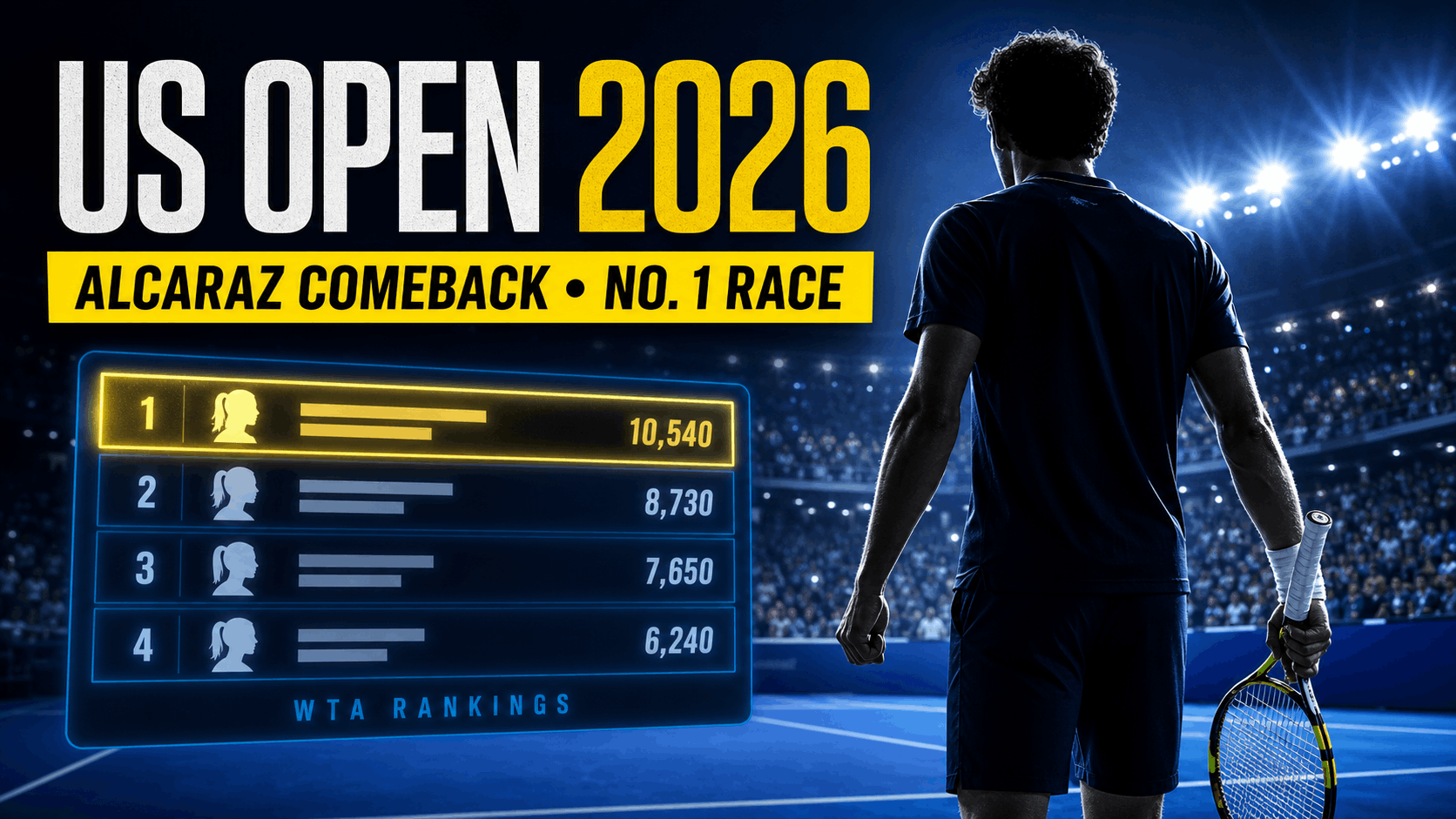
Alcaraz's long road back
Carlos Alcaraz has not played a competitive match since withdrawing from the Barcelona Open in April 2026 with a wrist injury. That single decision cost him four of the biggest events on the calendar — the French Open, Wimbledon, and the North American hard-court swing through Toronto and Cincinnati — more than four months without a Grand Slam or Masters appearance for the defending US Open champion.
He had originally targeted Cincinnati as his comeback event, but chose to give the wrist extra time rather than rush back into best-of-five tennis. In the weeks since, he gradually built up his workload and tested the injury at full intensity in training sessions with Holger Rune in Murcia, before confirming on August 20 that he would compete at Flushing Meadows.
The stakes are personal as well as competitive. The US Open is where Alcaraz won his first Grand Slam title in 2022, a run that also made him the youngest world No. 1 in ATP history. Defending that title after a four-month layoff, against a field that has kept playing and improving while he was out, is a very different challenge from the one he faced as a rising 19-year-old three years ago.
A WTA No. 1 race with four names on it
While Alcaraz's story is about one player finding his way back, the women's draw carries a subplot that could reshape the rankings entirely. Aryna Sabalenka arrives as world No. 1, closing in on 100 consecutive weeks at the top — but her grip on that ranking is not guaranteed to survive the tournament.
Elena Rybakina is in the strongest position of anyone in the draw, and not because of raw ranking points alone. Under the current scenarios, she becomes world No. 1 simply by reaching the semifinals — regardless of what Sabalenka, Coco Gauff or Jessica Pegula do elsewhere in the bracket. It is the kind of position built over a full season, not one tournament: an Australian Open title earlier in 2026 and a string of deep runs have steadily closed the gap.
Sabalenka's path to keeping the top spot is narrower. She needs to win the title outright, and she needs Rybakina to lose before the semifinal stage — both things have to go her way, not just one. Gauff and Pegula are the longest shots of the group: each would need to win the tournament herself and have Rybakina fall short of the last four. For either, it would be a first taste of the No. 1 ranking.
Why this US Open matters beyond the trophy
Grand Slam draws always carry storylines, but this one has two genuinely open questions running through it at once — whether a returning champion can still win best-of-five tennis after four months out, and who leaves New York with the No. 1 ranking in a race where the maths favours someone who might not even need to win a match to get there. Both threads play out over the same two weeks, at the same tournament, starting August 30.
More sports coverage
For more on how ranking races and knockout formats work across sports, see our explainer on the Champions League league phase format. More like this in our Sports section.


