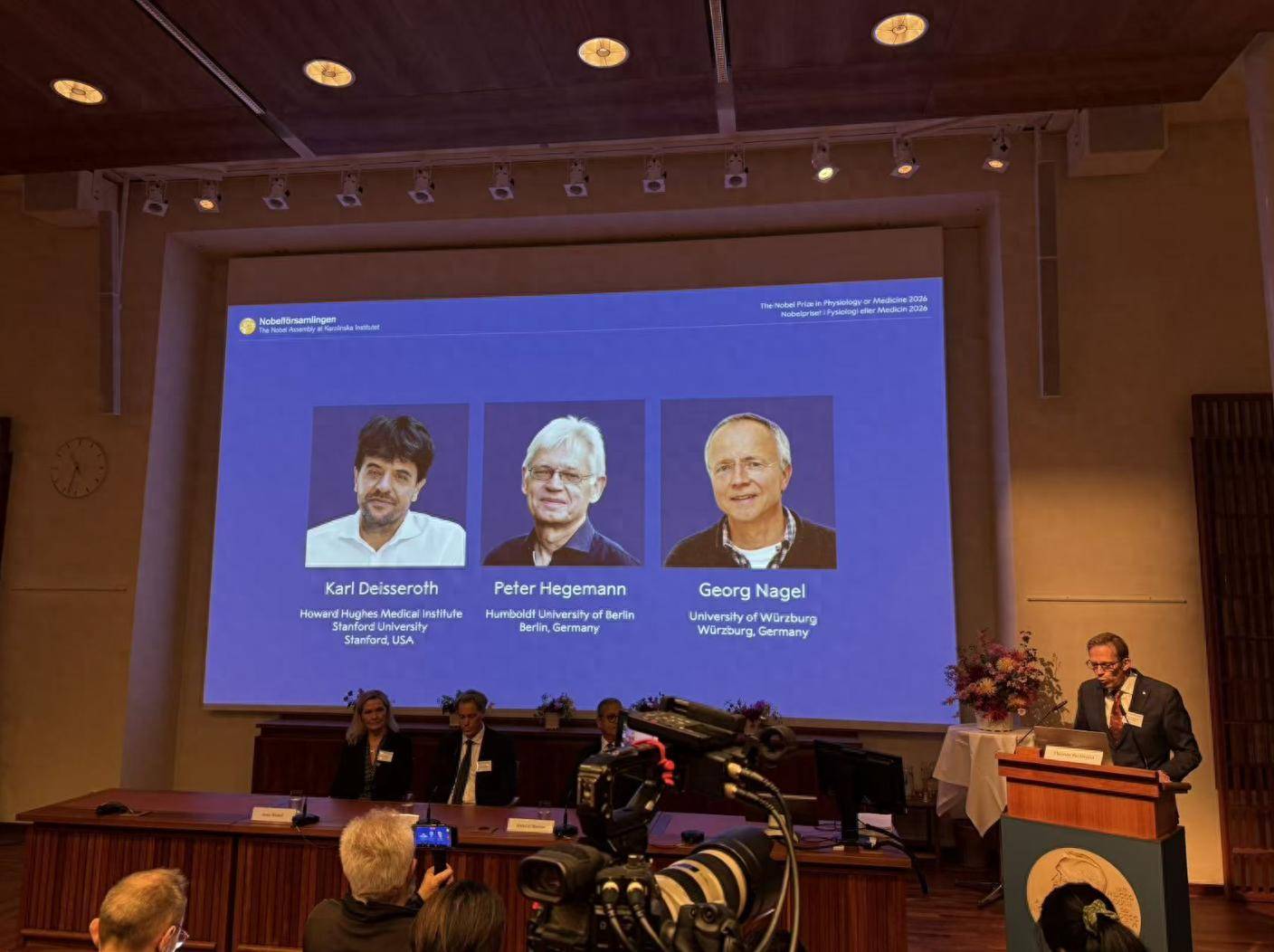
Henri B. Kagan and Kenso Soai have won the 2026 Nobel Prize in Chemistry for discoveries that help chemists understand and control the left- and right-handed forms of molecules. The Royal Swedish Academy of Sciences awarded the prize for the discovery of non-linear effects and autocatalysis in asymmetric organic synthesis.
The work matters because two molecules can contain the same atoms but behave differently when they are mirror images of each other. In medicine, producing the intended version reliably can determine whether a compound delivers the desired biological effect.
The 2026 Chemistry Nobel at a glance
The award was announced on the date in the Nobel Foundation's official 2026 announcement schedule. The Associated Press report identifies Kagan, affiliated with Université Paris-Sud in France, and Soai of Tokyo University of Science in Japan as the two laureates.
What chirality means in simple terms
Chiral molecules come in forms that are mirror images but cannot be placed perfectly on top of each other, much like a left hand and a right hand. Chemists call the two versions enantiomers.
That difference can change how a molecule interacts with enzymes, receptors and other biological structures, which are themselves three-dimensional. A familiar illustration is carvone: one mirror-image form is associated with a mint smell and the other with caraway. In drug development, the consequences can be far more important than scent.
Kagan's research showed that small imbalances in a reaction could produce unexpectedly large preferences for one molecular form. Soai later demonstrated an autocatalytic reaction in which a product helps make more of itself while amplifying one handedness. Together, the discoveries gave chemists both a way to control asymmetric synthesis and a model for how a strong molecular preference can emerge.
Why the discovery matters for medicines
Drug molecules must fit biological targets with precision. If one handed form binds as intended and its mirror image behaves differently, manufacturers need methods that favour the useful form and limit unwanted mixtures.
The laureates did not create one single medicine that explains the whole prize. Their influence is broader: asymmetric catalysts, selective reactions and a better understanding of chirality are part of the toolkit used across pharmaceutical research and production. The value lies in controlling reactions rather than separating two forms after both have already been made.
This is why the award sits naturally beside other technologies that turn foundational science into practical tools. MatchUpWorld's explainer on the 2026 medicine Nobel and optogenetics covers a different example: using light-sensitive proteins to control selected cells. The full 2026 Nobel announcement schedule tracks the remaining prize dates.
What the Nobel citation does and does not claim
The citation recognises foundational work on non-linear effects and autocatalysis in asymmetric organic synthesis. It does not mean that every chiral drug uses the Soai reaction directly, nor that molecular handedness was unknown before their research.
Kagan and Soai advanced different, connected parts of the problem. Kagan helped establish how asymmetric catalytic reactions could show non-linear behaviour. Soai produced a landmark reaction capable of self-amplification and extremely strong selectivity. The prize joins those contributions into an explanation of how chirality can be created, amplified and transmitted.
What happens next
The laureates are due to receive their medals and diplomas at the Nobel ceremony in Stockholm on December 10. The 12 million kronor award is for the whole chemistry prize and will be divided between them according to the Nobel decision.
Scientific interest will now extend beyond the ceremony. Researchers continue to study how small initial imbalances can produce one dominant handedness, including the larger question of why life on Earth uses particular molecular orientations.
Frequently asked questions
Who won the 2026 Nobel Prize in Chemistry?
Henri B. Kagan and Kenso Soai won for discoveries involving non-linear effects and autocatalysis in asymmetric organic synthesis.
What is molecular chirality?
It is the property of molecules that exist in non-superimposable mirror-image forms, comparable to left and right hands.
Why is chirality important in medicine?
Mirror-image forms of a molecule can interact differently with the body. Selective synthesis helps chemists produce the intended form consistently.
Sources: Nobel Prize announcement schedule, Associated Press, Chemistry & Engineering News.