John Ternus officially became Apple's chief executive on September 1, succeeding Tim Cook in the company's first CEO transition in 15 years.
The change was announced in April and unanimously approved by Apple's board. Cook has not left the company: he is now executive chairman and will continue to assist Apple in selected areas, including engagement with policymakers around the world.
That makes this a carefully managed handover rather than a clean break. Apple is placing a longtime hardware insider in charge while retaining the executive who led its expansion into a $4 trillion company.
Apple leadership change: the key facts
- John Ternus became Apple CEO on September 1, 2026.
- Tim Cook moved from CEO to executive chairman.
- Ternus also joined Apple's board of directors.
- Arthur Levinson became lead independent director after 15 years as non-executive chairman.
- Apple's board approved the succession unanimously.
- Ternus joined Apple in 2001 and has spent most of his career at the company.
For customers, there is no immediate change to Apple products, accounts or services. The significance is strategic: the person making the final calls on products, investment and priorities is now an engineer who has helped shape much of Apple's modern hardware.
Who is John Ternus?
Ternus, 50, is a mechanical engineer and one of Apple's longest-serving senior product leaders.
He joined Apple's product design team in 2001, became a vice president of Hardware Engineering in 2013 and entered the executive team in 2021 as senior vice president of Hardware Engineering.
Before Apple, he worked as a mechanical engineer at Virtual Research Systems. He holds a bachelor's degree in Mechanical Engineering from the University of Pennsylvania.
Ternus has generally kept a lower public profile than Cook, but Apple gradually put him in front of larger audiences at product launches and in media appearances. His responsibilities reached across the company's biggest hardware categories, including iPhone, iPad, Mac, Apple Watch and AirPods.
Which Apple products did Ternus help build?
Apple credits Ternus with playing an important role in the introduction of the iPad and AirPods, as well as generations of the iPhone, Mac and Apple Watch.
His hardware group was central to the Mac's transition to Apple-designed silicon. That shift gave Apple tighter control over performance, battery life and the connection between hardware and software.
Ternus also oversaw work related to product reliability, durability, repairability and lower-carbon materials. The record matters because it suggests that Apple's board chose a product operator rather than an outsider hired to rewrite the company's culture.
Reuters described him as a hardware veteran who helped revive the Mac and shaped products including the iPad and AirPods. His promotion signals continuity, but it also raises a major question: can a leader known for physical products accelerate Apple in an era increasingly defined by artificial intelligence?
Why did Apple choose John Ternus?
Apple's decision follows a familiar pattern. Cook was already a deeply experienced insider when he succeeded Steve Jobs in 2011. Ternus now arrives with 25 years of institutional knowledge and direct experience managing the teams behind Apple's most valuable devices.
There are three clear advantages to that choice.
First, Apple avoids the disruption that can accompany an external CEO. Ternus understands the company's secretive product-development process and its unusually close integration of chips, hardware, software and services.
Second, his background fits a moment when Apple needs new device categories as well as better software. The iPhone remains central to the company's ecosystem, while wearables, spatial computing and future form factors all depend on hardware execution.
Third, Cook remains available as executive chairman. That gives Ternus continuity in areas where Cook has extensive relationships, particularly policy, supply chains and international operations.
What does Tim Cook's executive-chairman role mean?
Executive chairman is an active board position, but it is not the same as being CEO.
Ternus is now responsible for running Apple. Cook leads the board and, according to Apple, will assist with certain aspects of the business, including contact with policymakers. The company did not say that Cook would continue managing daily operations.
The distinction will matter whenever Apple makes a major strategic decision. Ternus has the chief executive's authority, while Cook can provide advice, oversight and continuity from the board.
It is also a sign that Apple wants to reduce transition risk. Cook's 15-year tenure produced extraordinary growth: Apple says its market value rose from about $350 billion to $4 trillion and annual revenue increased from $108 billion in fiscal 2011 to more than $416 billion in fiscal 2025.
The biggest challenge: Apple's AI strategy
Ternus takes charge as competition in generative AI reshapes the technology industry.
Reuters identified the integration of AI into the iPhone as potentially his hardest challenge. Apple has enormous advantages—a large installed base, custom silicon and control over its operating systems—but investors and users will judge the company on what its AI features can actually do.
The issue is bigger than adding a chatbot. Apple must make Siri more useful, protect user privacy, deliver features reliably across devices and give developers reasons to build around its platforms.
This is where Ternus's hardware background could help or hurt. Close coordination between chips, memory, batteries and software can make on-device AI faster and more private. But leading the AI race also requires rapid software development, strong models and dependable cloud infrastructure.
The first evidence of his priorities will come from product decisions, executive appointments and the pace at which announced features reach customers—not from launch-day slogans.
Can a hardware engineer lead a software and services giant?
Apple is no longer only a device maker. Services became a business generating more than $100 billion a year under Cook, according to the company. The installed base has grown beyond 2.5 billion active devices.
That means Ternus must manage two connected businesses at once.
The first sells premium hardware. The second earns recurring revenue from services including the App Store, iCloud, Apple Music, Apple Pay and Apple TV. Hardware brings users into the ecosystem; software and services make that ecosystem more valuable over time.
Ternus does not need to personally design every service. He does need to set priorities across product groups and ensure that Apple's software ambition matches the engineering quality of its devices.
What changes for the iPhone, Mac and Apple Watch?
Nothing changes overnight. Apple plans products years ahead, so devices arriving in the near term were developed while Cook was CEO and Ternus led hardware engineering.
Any distinct Ternus era will emerge gradually through the projects that receive funding, the risks Apple accepts and the products it cancels. His existing influence also means the new era may look more evolutionary than revolutionary at first.
Customers should watch for improvements that combine hardware and software: battery-efficient AI, more capable sensors, stronger device continuity, longer product life and new ways to interact with computers.
Reports and analyst predictions about unannounced products should still be treated as speculation until Apple confirms them.
What will happen to Apple's culture?
Ternus is an internal successor, so a sudden cultural reset is unlikely.
Apple's public values around privacy, accessibility, environmental goals and tightly integrated products are likely to remain. The company said Ternus would carry its mission forward, and Cook's position as executive chairman adds another layer of continuity.
The more revealing cultural question is how quickly Apple moves. AI companies often ship early and update frequently. Apple traditionally waits until it believes a feature is polished enough for a mass audience. Ternus must decide where that patience protects the brand and where it causes the company to fall behind.
What investors will watch under Ternus
The share price on one day will not determine whether the transition succeeds. Investors will look for measurable progress across several areas:
- Whether Apple delivers competitive and reliable AI features
- Whether iPhone demand remains resilient worldwide
- Whether new hardware categories can become meaningful businesses
- Whether services continue to grow without damaging customer trust
- How Apple handles regulation, tariffs and geopolitical pressure
- Whether margins remain strong as computing costs rise
Leadership transitions at companies of Apple's size are judged over years. Ternus inherits enormous scale, but that scale also makes breakthrough growth harder.
What Apple users should watch next
Users do not need to take any action because of the CEO change. Apple IDs, subscriptions, warranties and device support continue as normal.
The practical signs of Ternus's leadership will appear in future product launches, operating-system updates and the quality of customer experiences. Watch whether promised AI functions arrive on time, whether older devices remain supported and whether Apple introduces genuinely useful products rather than small annual changes.
It is equally important to watch what stays the same. Cook's move to executive chairman, Ternus's long Apple career and the months-long transition all point to stability.
A new Apple era, with Tim Cook still in the room
September 1 marks a historic change at Apple, but not an abrupt one.
John Ternus takes the CEO title after spending a quarter-century inside the company and overseeing the hardware behind its ecosystem. Tim Cook moves upstairs to chair the board after transforming Apple into a global business with more than 2.5 billion active devices.
The transition gives Apple continuity at the top. The test is whether Ternus can convert that stability into faster progress in AI and the next generation of personal technology.
Sources
- Apple: Tim Cook to become Apple Executive Chairman; John Ternus to become Apple CEO
- Reuters: Apple turns to hardware veteran Ternus as CEO to succeed Cook in AI age
- Reuters: Who is John Ternus, Apple's new CEO?
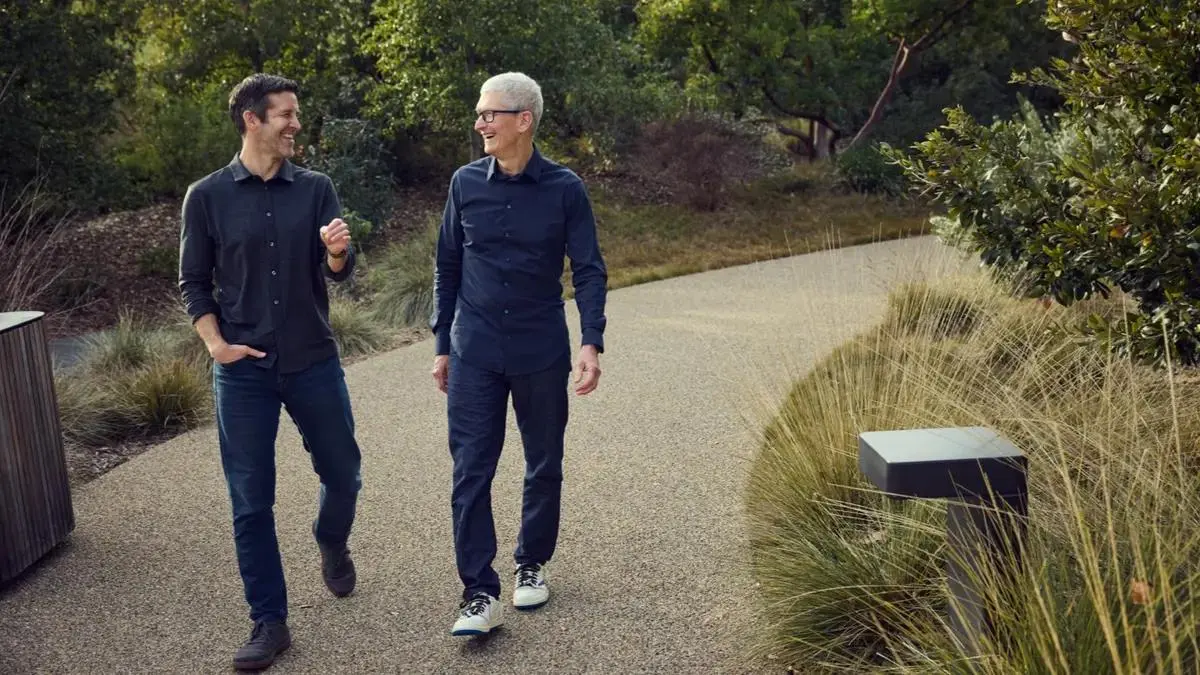
Thumbnail: John Ternus and Tim Cook at Apple Park. Photo courtesy of Apple.