The basic structure
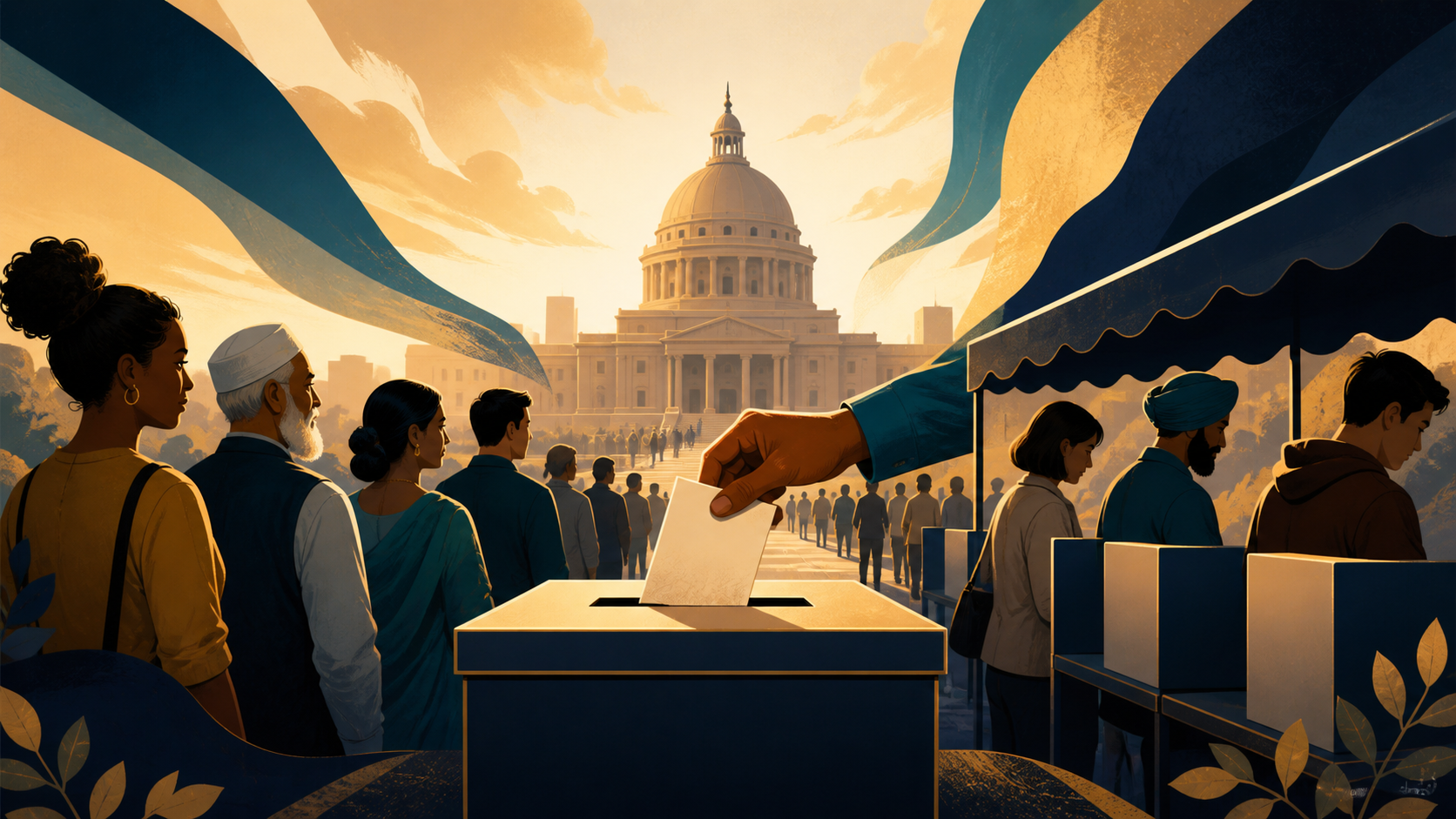
India's Lok Sabha, the lower house of Parliament, is elected through 543 individual constituencies, each represented by a single Member of Parliament. Voters do not vote for a party directly for the national government — they vote for a candidate standing in their own local constituency, and whichever party or coalition wins enough of those individual seats forms the government.
First-past-the-post voting
Each constituency is decided by first-past-the-post voting: whichever candidate gets the most votes in that constituency wins the seat outright, even if they do not cross fifty percent of the total votes cast there. In a constituency with several candidates splitting the vote, it is entirely possible to win a seat with well under half the votes, simply by finishing ahead of every individual rival.
Why seat share and vote share can diverge sharply
Because every seat is won individually rather than through proportional representation, a party's national seat count does not need to match its national vote percentage. A party that wins narrowly in a large number of constituencies can end up with far more seats than its overall vote share would suggest, while a party with votes spread evenly but never quite enough to win individual seats can end up with a seat count far smaller than its vote share. This is a structural feature of first-past-the-post systems generally, not something unique to India.
Forming the government
The party or pre-declared coalition that can command a majority of seats, more than half of 543, gets to form the government, with its leader appointed Prime Minister by the President. When no single party crosses that threshold alone, coalition government becomes necessary, built from post-election alliances between parties willing to govern together.
The Election Commission's role
The Election Commission of India, a constitutional body independent of the government of the day, is responsible for conducting the entire election — from announcing the schedule to overseeing polling and counting. Its independence is a deliberate design choice, intended to ensure that the party in power at the time of an election does not also control how that election is run.
Constituency boundaries themselves are not fixed forever either — see our explainer on delimitation for why redrawing them is one of the most politically sensitive exercises in Indian governance. More like this in our Politics section.