Chinese artificial-intelligence chipmaker Enflame Technology has priced its Shanghai initial public offering to raise approximately 6.1 billion yuan, or $908 million, as China accelerates investment in domestic alternatives to Nvidia hardware.
The Tencent-backed company set its IPO price at 142.18 yuan per share and plans to sell about 43 million shares on the Shanghai Stock Exchange's technology-focused STAR Market. Investor subscriptions are scheduled to open on September 2, 2026.
The offering will raise slightly more than Enflame's original 6 billion yuan target. The company says the proceeds will fund fifth- and sixth-generation AI chips alongside advanced hardware and software projects.
Enflame IPO: key numbers
- Company: Shanghai Enflame Technology Co.
- Stock code: 688801
- Exchange: Shanghai STAR Market
- IPO price: 142.18 yuan per share
- Shares offered: Approximately 43.04 million
- Expected proceeds: About 6.1 billion yuan, or $908 million
- Subscription date: September 2, 2026
- Business: Cloud AI processors, accelerator cards, computing systems and software
- Major investor and customer: Tencent
- Profit status: Not yet profitable
The shares represent roughly 10% of Enflame's enlarged capital after the offering, based on its earlier regulatory filing. CITIC Securities is sponsoring the listing, with Guotai Haitong and GF Securities involved as joint lead underwriters.
What does Enflame make?
Founded in Shanghai in 2018, Enflame develops processors and systems designed for artificial-intelligence workloads in data centres. Its products target both AI training, where models learn from huge datasets, and inference, where trained models generate predictions or responses.
The company is commonly grouped with Moore Threads, MetaX and Biren Technology as one of China's leading domestic GPU challengers. These businesses are attempting to build local computing platforms that can reduce dependence on foreign suppliers.
An AI accelerator is not valuable only because of its raw chip specifications. Customers also require development tools, software libraries, networking, system support and compatibility with popular AI frameworks. That is why Enflame plans to direct part of the IPO money toward coordinated hardware-software development rather than chip production alone.
Why the IPO matters beyond China
Advanced AI chips have become strategically important because they power large language models, recommendation systems, autonomous technology and scientific computing. Nvidia dominates much of the global market, but US export restrictions limit the most advanced products and chipmaking technologies that can be supplied to China.
Beijing has responded by making semiconductor self-sufficiency a national priority. Enflame's listing gives the company access to public capital for the expensive process of designing, testing and commercialising new generations of chips.
The outcome will be watched by investors in the United States, Europe and Asia. A stronger Chinese AI-chip ecosystem could affect demand for foreign processors, influence data-centre spending and create new competitors across hardware and software.
It could also shape the direction of two partially separate technology ecosystems. If Chinese customers increasingly adopt domestic accelerators, developers may optimise models and software around local platforms instead of systems built primarily around Nvidia's CUDA environment.
Tencent's role in Enflame
Tencent is both a major shareholder and Enflame's biggest customer. That relationship offers obvious advantages: Enflame gains funding, technical feedback and demand from one of China's largest internet and cloud companies.
Tencent operates gaming, social-media, cloud and AI services that require substantial computing capacity. A close customer can help a chip designer test products in real data-centre workloads and improve them more quickly.
The concentration also creates risk. Heavy dependence on one customer can make revenue less diversified and give that customer significant bargaining power. Investors will therefore watch whether Enflame expands sales to other cloud providers, state-backed computing projects and enterprise customers after the listing.
Tencent's presence should not be interpreted as a guarantee that Enflame will become profitable or successfully challenge Nvidia. It does, however, give the startup a strategic supporter with both capital and a practical need for AI infrastructure.
Enflame's IPO valuation explained
Enflame said its IPO price values the unprofitable company at 61.8 times its 2025 sales. This is a price-to-sales multiple, calculated by comparing the company's equity valuation with annual revenue.
The filing compared that figure with multiples above 160 times sales for listed Chinese rivals Moore Threads and MetaX. Nvidia was trading at approximately 25.4 times 2025 sales under the same comparison.
Those numbers do not prove that one stock is cheap or expensive by themselves. Investors may assign higher multiples to businesses expected to grow faster, but a high valuation also leaves less room for missed targets.
Enflame remains unprofitable, making conventional price-to-earnings comparisons impossible. Its market value will therefore depend heavily on expectations for revenue growth, product adoption, research execution and future margins.
How the $908 million will be used
Enflame plans to invest in the development and production of fifth- and sixth-generation AI chips. Moving from a successful design to commercial deployment requires several expensive stages:
- Processor architecture and verification
- Software tools and developer support
- Manufacturing and advanced packaging
- Accelerator boards and complete computing systems
- Data-centre testing and customer qualification
- Research for future chip generations
The company also plans advanced AI hardware-software collaboration projects. That spending is important because a technically capable chip can struggle commercially if developers find it difficult to program or integrate.
The IPO capital gives Enflame a larger financial base, but semiconductor development remains high risk. Delays, manufacturing problems or weak software support can reduce the value of years of research.
Can Enflame compete with Nvidia?
Enflame says it aims to help China break Nvidia's dominance in AI chips, but direct global competition will not happen overnight.
Nvidia's advantage includes mature software, networking technology, full computing systems and an enormous developer community. Customers often choose its platform because their existing models and tools already work there, not simply because of benchmark performance.
Enflame's more immediate opportunity is domestic. Chinese cloud companies and organisations affected by export controls have a strong incentive to test local alternatives. Government support and strategic procurement may create demand while the technology improves.
Success will depend on whether Enflame can deliver competitive performance at acceptable power consumption, manufacture chips reliably and build software that reduces migration costs for customers.
The IPO does not mean Nvidia's position has been broken. It means another well-funded challenger now has public-market capital to pursue that goal.
China's wave of AI and semiconductor listings
Enflame follows Moore Threads, MetaX and Biren Technology into public markets. The sequence shows how Chinese exchanges are being used to finance companies considered strategically important even before they reach consistent profitability.
The STAR Market's listing rules allow qualifying technology companies with accumulated losses to go public based on market value, revenue, research investment and other measures. That structure was designed to support businesses whose development cycles do not fit traditional profit requirements.
The broader Chinese IPO market has also been boosted by investor interest in AI, robotics and advanced manufacturing. Strong demand can produce rapid price gains, but recent volatility in some newly listed technology companies demonstrates the risk of paying extreme valuations for future growth.
What investors should watch next
The first milestone is investor subscription on September 2. After allocation and listing, attention will shift to trading performance and the company's operational disclosures.
Important questions include:
- How quickly revenue grows after the IPO
- Whether customer concentration around Tencent declines
- Progress on fifth- and sixth-generation products
- Research and manufacturing spending
- The timeline for profitability
- Adoption outside state-backed or closely connected customers
- Performance against Moore Threads, MetaX, Biren and foreign chips
Enflame's IPO sits at the intersection of capital markets, artificial intelligence and US-China technology competition. The $908 million raise gives the company substantial resources, but investors are paying for expected progress rather than current profits.
That tension—strategic importance versus financial execution—will determine whether Enflame becomes a durable public AI-chip company or another example of expectations moving faster than commercial results.
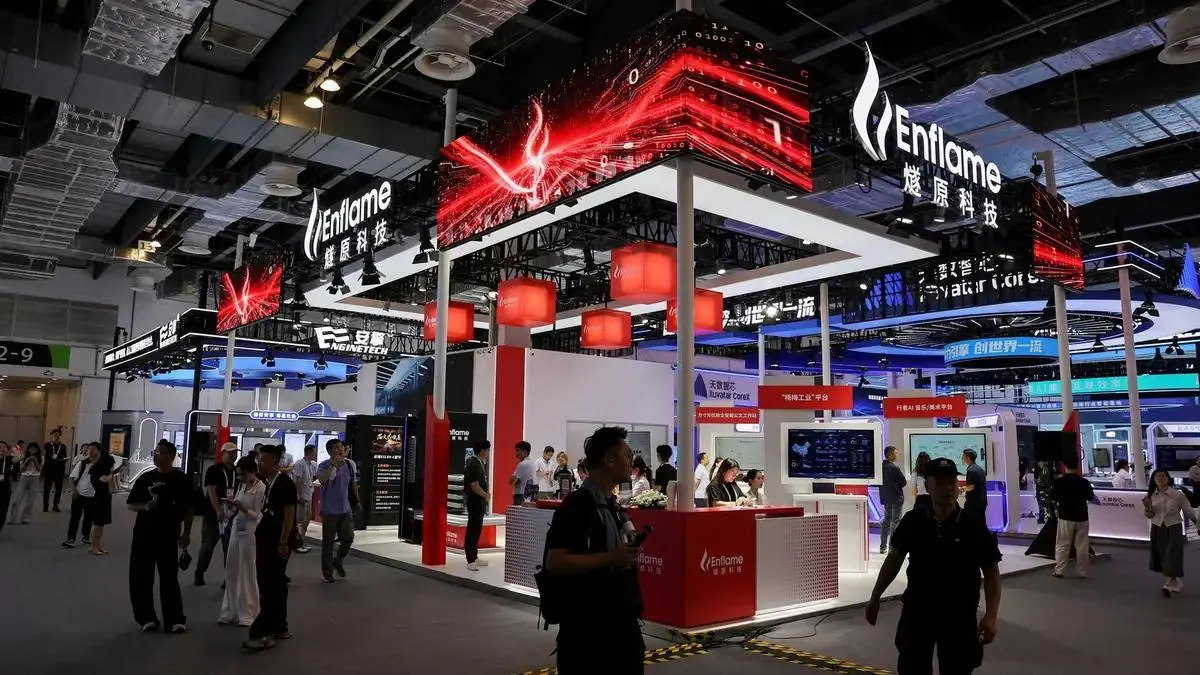
Photo: Visitors walk past the Enflame booth at the World Artificial Intelligence Conference in Shanghai on July 17, 2026. Reuters/Go Nakamura.