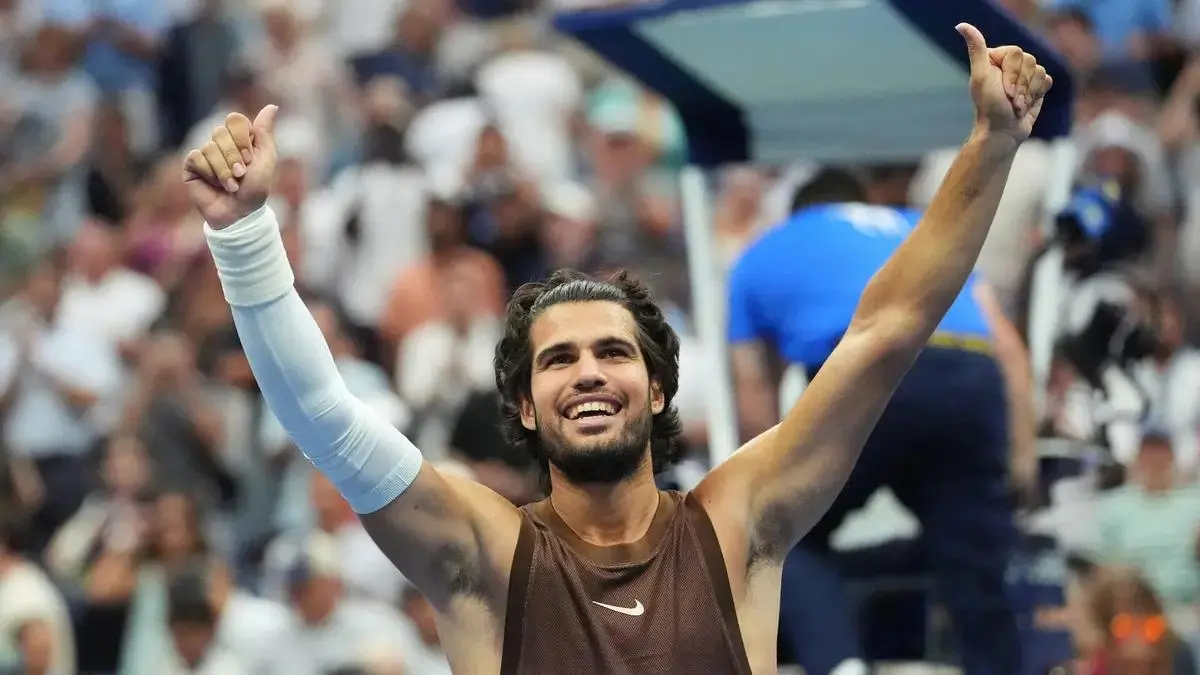
Carlos Alcaraz returned to Grand Slam singles competition with a result that answered the first—and most urgent—question surrounding his 2026 US Open campaign.
The defending champion defeated Roman Safiullin 6-4, 6-4, 6-4 at Arthur Ashe Stadium on Monday, completing his first singles match in 139 days after a right-wrist injury kept him away from the tour for nearly five months.
Alcaraz reported that his wrist and arm felt good during the match, an encouraging start for a player attempting to defend the title without the usual sequence of warm-up tournaments.
The Spaniard will face Portugal’s Jaime Faria in the second round.
Alcaraz vs Safiullin: match details
- Tournament: 2026 US Open
- Round: Men’s singles first round
- Winner: Carlos Alcaraz
- Opponent: Roman Safiullin
- Score: 6-4, 6-4, 6-4
- Venue: Arthur Ashe Stadium, New York
- Alcaraz’s singles absence before the match: 139 days
- Next opponent: Jaime Faria of Portugal
- Injury status after the match: Alcaraz said he played without wrist pain
The straight-sets score suggests a routine opening win, but the context made it one of the most closely watched matches of the tournament’s opening days.
Why Alcaraz’s return was uncertain
Alcaraz had not played a singles match since April because of an injury to his dominant right wrist.
Wrist problems are especially concerning for an aggressive player whose forehand is central to both his defence and attack. The joint must absorb stress during acceleration, contact and follow-through. A player may feel comfortable in practice but still experience discomfort when reacting at full speed in a competitive match.
The injury forced Alcaraz to withdraw from the Barcelona Open and removed him from a significant section of the 2026 season. He missed the French Open and Wimbledon, losing valuable match rhythm before the final major of the year.
His only recent competitive appearance came in US Open mixed doubles alongside Serena Williams. That offered exposure to the court and crowd, but doubles points are generally shorter and require different movement patterns from a best-of-five-set men’s singles match.
Monday was therefore the first meaningful test of whether his wrist could tolerate sustained serving and repeated full-power forehands.
How the match unfolded
Alcaraz settled into the contest quickly and used his forehand to create the decisive moments.
In the opening set, he broke Safiullin in the seventh game with a forehand winner and protected the advantage to take the set 6-4.
The second set brought his clearest difficult spell. Safiullin earned an early break, but the Russian surrendered the advantage in the following game. Alcaraz then secured another break in the seventh game and again closed the set 6-4.
By the third set, the defending champion appeared increasingly comfortable. He converted another break opportunity with his forehand and avoided the extended physical contest that would have tested his conditioning more severely.
Alcaraz finished the match with more than 20 forehand winners, according to Reuters. The number was significant because the shot most dependent on his injured side remained his strongest weapon.
He did not lose a set, did not need a tiebreak and avoided a fourth set. For a player returning after nearly five months, reducing time on court was almost as valuable as the result.
Carlos Alcaraz wrist injury update
The immediate update was positive: Alcaraz said after the match that his arm and wrist felt great and that he was finally pain-free.
He also made clear that he will continue managing the wrist between matches. That is important because a successful first round does not prove that the injury is completely behind him.
Grand Slam recovery is cumulative. A player can feel comfortable during one match but experience stiffness or soreness the following morning. The second test is whether the wrist responds well to recovery and another high-intensity session.
Alcaraz’s team will likely monitor:
- Pain or stiffness after serving
- Swelling and range of motion
- Forehand speed and accuracy
- Ability to change direction under pressure
- Recovery during the tournament’s one-day breaks
There was no public indication after the first-round win that he would be unable to continue.
Why his forehand performance mattered
Alcaraz’s forehand is not simply a finishing shot. It shapes his entire point construction.
He uses heavy topspin to push opponents behind the baseline, then changes pace with flatter attacks or drop shots. The threat of a powerful forehand also creates space for him to move forward.
If the wrist limited that shot, opponents could direct more balls to his forehand side without fearing an immediate winner. Safiullin attempted to pressure him, particularly during the early break in the second set, but Alcaraz continued accelerating through the ball.
More than 20 forehand winners indicate that he trusted the shot in competitive situations. The three-set victory also allowed him to test the wrist without playing the longest possible match.
Was Alcaraz at his best?
Not completely—and that may be encouraging.
There were understandable signs of nerves and missing match rhythm. Alcaraz acknowledged that the day was emotionally difficult despite the win. His tennis was effective rather than flawless, and he was briefly broken in the second set.
What mattered was his response. He broke back immediately, regained control and prevented Safiullin from turning the match into a physical battle.
A player returning from injury does not need peak tennis in the opening round. He needs a performance that protects the body, rebuilds confidence and creates another opportunity to improve.
Alcaraz achieved all three.
Who is Carlos Alcaraz playing next?
Alcaraz will play Portuguese player Jaime Faria in the second round.
The match presents a different kind of pressure. Safiullin was the first test after the injury, so the focus was largely on Alcaraz’s health. Against Faria, expectations will shift toward performance and progress.
The defending champion will want another efficient match, but he cannot afford to treat it as a recovery session. Early-round opponents often play freely against major champions because they have little external pressure and a career opportunity on a large stage.
For Alcaraz, the priorities should remain simple:
- Protect the first serve
- Avoid long stretches of rushed errors
- Continue trusting the forehand
- Keep points varied with movement and touch
- Finish efficiently if he earns an early lead
The official match time should be checked on the US Open schedule when the order of play is confirmed, as court assignments can change.
What the result means for the men’s draw
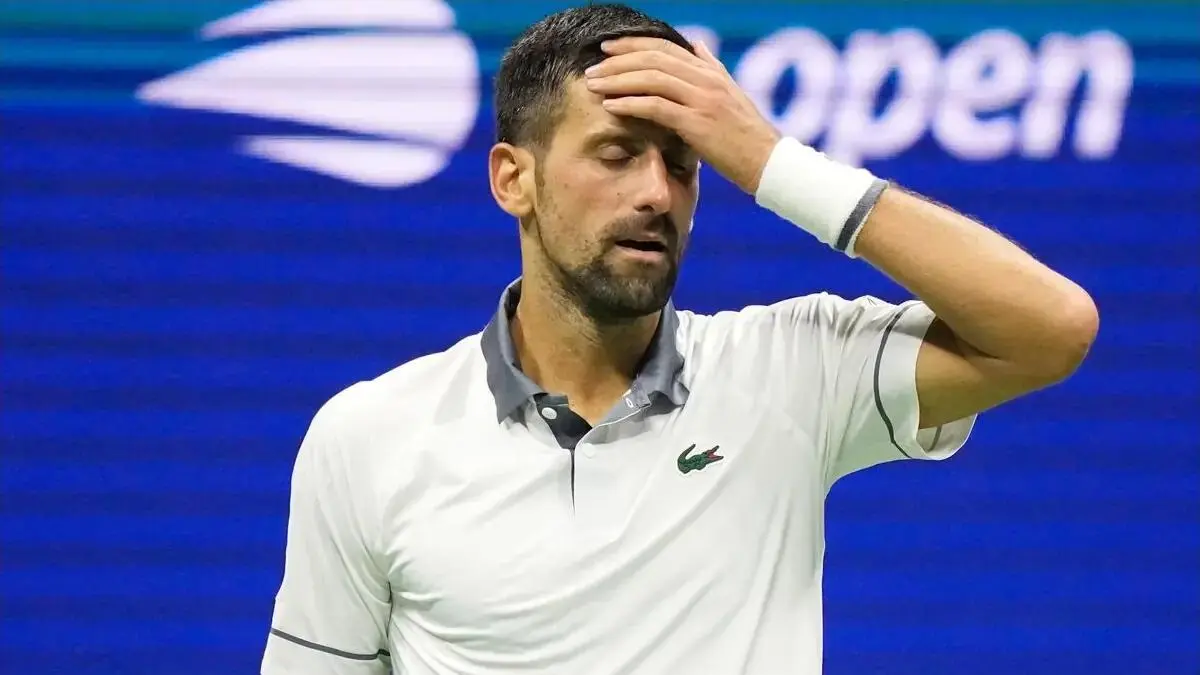
Alcaraz’s healthy return carries extra importance after Novak Djokovic’s surprise exit and Jannik Sinner’s absence through injury.
The men’s field has already lost major star power. A defending champion who can move freely and strike his forehand without pain becomes an even more significant title contender.
However, tournament favouritism should be treated cautiously. Alcaraz has completed only one singles match since April. A Grand Slam champion must win seven matches over two weeks, often against increasingly powerful opponents.
Questions remain about his endurance in a four- or five-set match, recovery after consecutive rounds and confidence if the wrist feels uncomfortable under pressure.
The opening victory reduced those concerns; it did not eliminate them.
Alcaraz’s US Open title defence
Alcaraz is attempting to become the first man since Roger Federer to defend the US Open title successfully.
Federer won five consecutive championships in New York from 2004 through 2008. Since then, the men’s event has produced champions with very different styles, but no player has won in back-to-back years.
That history shows how difficult the tournament can be to control. Late-night sessions, humid conditions, powerful hard-court opponents and an intense New York crowd create a distinctive test.
Alcaraz already understands the environment. He is a two-time champion at the event and received a loud welcome when he returned to Arthur Ashe Stadium.
Experience cannot replace match fitness, but it helps a player manage the atmosphere and the moments when an early-round opponent gains momentum.
How the injury changed expectations
Before the wrist problem, Alcaraz would have entered the tournament with one clear objective: win the title.
After 139 days away, success has more layers.
Completing matches pain-free matters. Regaining confidence in the forehand matters. Recovering normally between rounds matters. Each win provides valuable evidence for the rest of the tournament and the season beyond New York.
Alcaraz said he did not know how far he would go and wanted to enjoy being back on court. That position is realistic, not an attempt to lower expectations. Even elite players cannot accurately predict how their body will respond after a long absence.
The first round showed that his championship-level weapons remain available. The coming rounds will reveal whether he can reproduce them across a full major.
Three things to watch against Faria
1. First-serve consistency
Free points will reduce stress on the wrist and help Alcaraz avoid long service games. A falling first-serve percentage could expose him to more physical rallies.
2. Recovery after the opening match
How he moves and swings early in the second round may be more informative than any post-match statement. Hesitation on the forehand would suggest soreness or reduced confidence.
3. Patience under pressure
Long layoffs can affect decision-making. Alcaraz is at his best when he combines power with variation rather than trying to end every rally immediately.
The bottom line
Carlos Alcaraz’s US Open comeback began with a 6-4, 6-4, 6-4 victory over Roman Safiullin after 139 days without a singles match.
The most reassuring part was not only the straight-sets score. It was his ability to produce more than 20 forehand winners and finish the match without wrist pain.
He now faces Jaime Faria in the second round, where attention will shift from the fact of his return to the quality and durability of his tennis.
One match cannot confirm that Alcaraz is ready to defend the title. It did confirm that the defending champion is healthy enough to begin the attempt—and that he remains one of the most dangerous players in the draw.
Sources
- Reuters: Pain-free Alcaraz makes winning return after injury layoff, August 31, 2026
- US Open: Monday results and highlights, August 31, 2026
- Official US Open Carlos Alcaraz player profile and tournament information