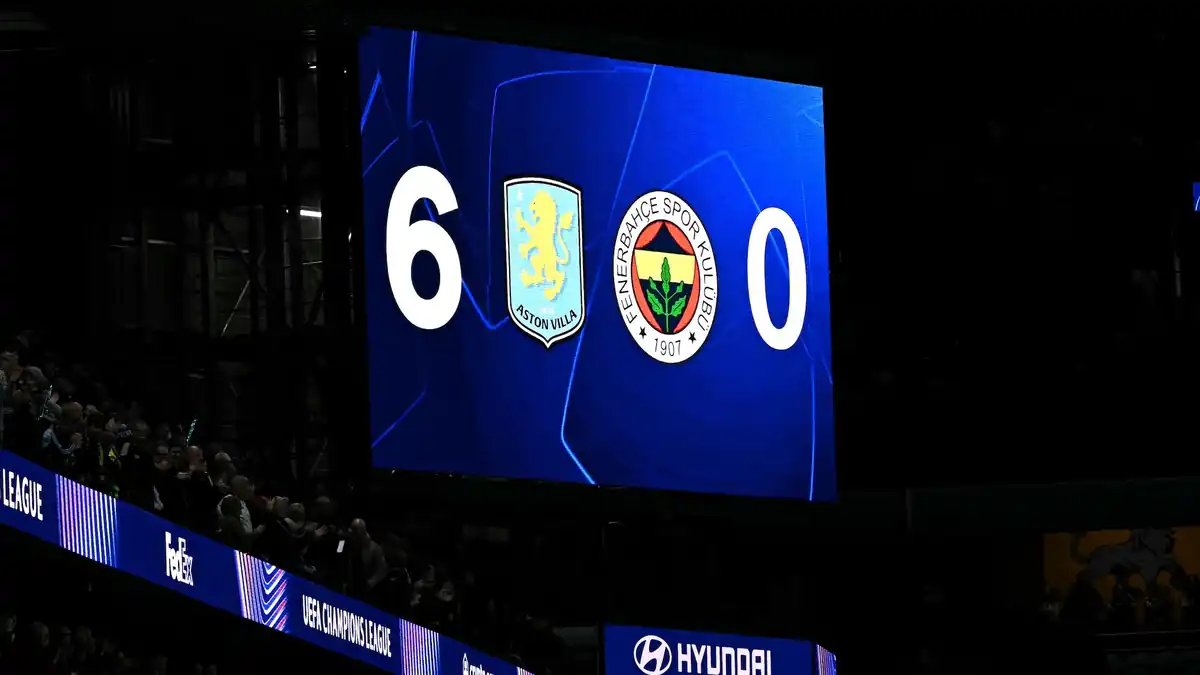
Photo: Getty Images / UEFA; photograph from the Aston Villa–Fenerbahçe match. Original image source.
The Champions League produced 78 goals in 18 matches on October 13–14, setting a new matchday record according to UEFA. For supporters catching up over the weekend, the useful comparison is not only the headline total: the round averaged 4.33 goals per game.
That figure comes from dividing UEFA’s total by the number of fixtures. It helps explain how extraordinary the two nights were without confusing a matchweek with a single night or an individual match.
The comparison behind the 78-goal record
UEFA’s updated record book puts the previous best at 71 goals in 18 games, on Matchday 3 of 2025/26. The new total is seven higher: an increase of about 9.9%, with the number of matches unchanged.
The expanded league phase gives a round more opportunities to accumulate goals than an older 16-game group-stage round. That is why comparing totals across formats needs care. In this particular comparison, however, both rounds contained 18 matches, making the seven-goal improvement easier to interpret.
A six-goal win and a nine-goal game tell different stories
Aston Villa beat Fenerbahçe 6–0, while Liverpool won 6–3 at LASK. Roma’s 3–4 defeat by Real Madrid was another high-scoring fixture. The official fixtures and results let readers check individual scores rather than rely on a highlights montage.
Those examples show why a scoring record cannot, on its own, identify its cause. A one-sided victory contributes differently from an open contest in which both teams score repeatedly. The aggregate does not measure chance quality, defensive organization or how a team managed the game after taking the lead.
For the same reason, 78 goals should not be treated as a prediction for the next round. It describes what happened across these fixtures; it does not establish that every side has become more attacking or that future matches will follow the same pattern.
Keep the three records separate
A matchday can span more than one date. A single-night record counts games played on one evening, while the highest-scoring match is a separate category again. Mixing those labels produces an impressive headline with the wrong meaning.
The clearest description here is the highest-scoring Champions League matchday in UEFA’s listed group-stage and league-phase comparison. Our league-phase format guide explains the wider competition structure. The Sports section follows international football and other major events.
