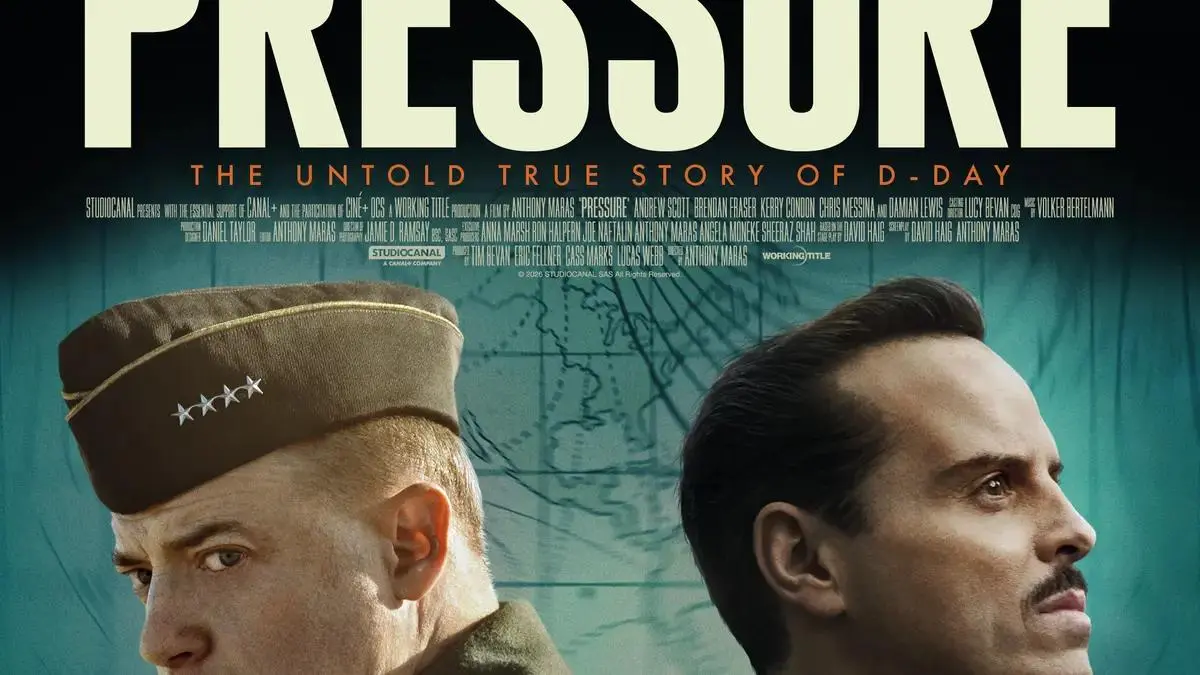
Pressure, a World War II drama starring Andrew Scott and Brendan Fraser, is bringing one of D-Day's least visible but most consequential decisions to cinemas: whether the weather would allow the Allied invasion of Normandy to begin.
The film started its global theatrical rollout and is scheduled to open in the United Kingdom on September 9, 2026. It is adapted from David Haig's stage play and directed by Anthony Maras.
Scott plays Scottish meteorologist Captain James Stagg, while Fraser portrays General Dwight D. Eisenhower. Damian Lewis appears as Field Marshal Bernard Montgomery, with Kerry Condon also in the principal cast.
The true story behind Pressure
In June 1944, Allied commanders had to choose a narrow window for the largest amphibious invasion in history. Troops, aircraft and ships were ready, but poor weather could destroy landing operations before soldiers reached the beaches.
Stagg was responsible for presenting the forecast to Eisenhower. He warned that the planned June 5 launch faced dangerous conditions and supported delaying the invasion by 24 hours.
The decision was extraordinary. A delay risked revealing preparations, exhausting troops and losing the required combination of tides and moonlight. Proceeding in severe weather could have produced catastrophe.
Eisenhower accepted the recommendation. The landings began on June 6, 1944, under imperfect but workable conditions. German forecasters had reached different conclusions, contributing to reduced expectations of an immediate attack.
Why weather becomes a thriller
The film does not need to invent a ticking clock. Every hour before D-Day carried consequences for millions of people and the future of Europe.
Meteorology in 1944 relied on observations, human calculations and competing interpretations rather than modern satellites. Stagg could not offer certainty; he could only explain the most likely outcome and accept responsibility if he was wrong.
That uncertainty gives Pressure its drama. The conflict is not simply between armies, but between scientific judgment and commanders facing political and military pressure to act.
Brendan Fraser as Eisenhower
Fraser has described the film as a warning against dismissing science. His Eisenhower must project authority while listening to expertise that cannot promise a perfect answer.
The role differs from a conventional heroic portrait. Leadership is shown through the willingness to delay, absorb criticism and make a decision whose result will only become clear after thousands of troops are committed.
Fraser's recent career revival gives the film additional attention, while his physical presence suits the burden carried by the Allied commander.
Andrew Scott as James Stagg
Scott's character is the specialist in a room dominated by senior military figures. His task is to make uncertain atmospheric data persuasive to people planning an operation on an unimaginable scale.
The performance depends on controlled pressure rather than battlefield action. Stagg knows that hesitation may be interpreted as weakness, yet false confidence would betray the responsibility of a scientist.
Scott has described the story as a David-and-Goliath struggle. Stagg's authority comes from evidence, not rank, which puts him in direct conflict with leaders eager to proceed.
Release information
- UK cinema date: September 9, 2026
- Director: Anthony Maras
- Based on: David Haig's 2014 stage play
- Andrew Scott: Captain James Stagg
- Brendan Fraser: Dwight D. Eisenhower
- Damian Lewis: Bernard Montgomery
- Genre: historical drama and wartime thriller
Release dates may differ internationally, so viewers should check local cinema listings rather than assuming a simultaneous opening everywhere.
Why the story feels current
The film's central argument extends beyond wartime history. Governments still make high-stakes decisions using scientific models that contain uncertainty—during pandemics, natural disasters and climate emergencies.
Uncertainty does not mean expertise has failed. It means leaders must understand probability and act before complete information becomes available.
Pressure turns that principle into a human confrontation. Stagg must communicate clearly; Eisenhower must decide whether to trust him; and everyone understands the cost of error.
The D-Day landings are familiar history. The forecast behind them is less widely known. By placing that decision at the centre, Pressure offers a war film in which the most important weapon is judgment.
