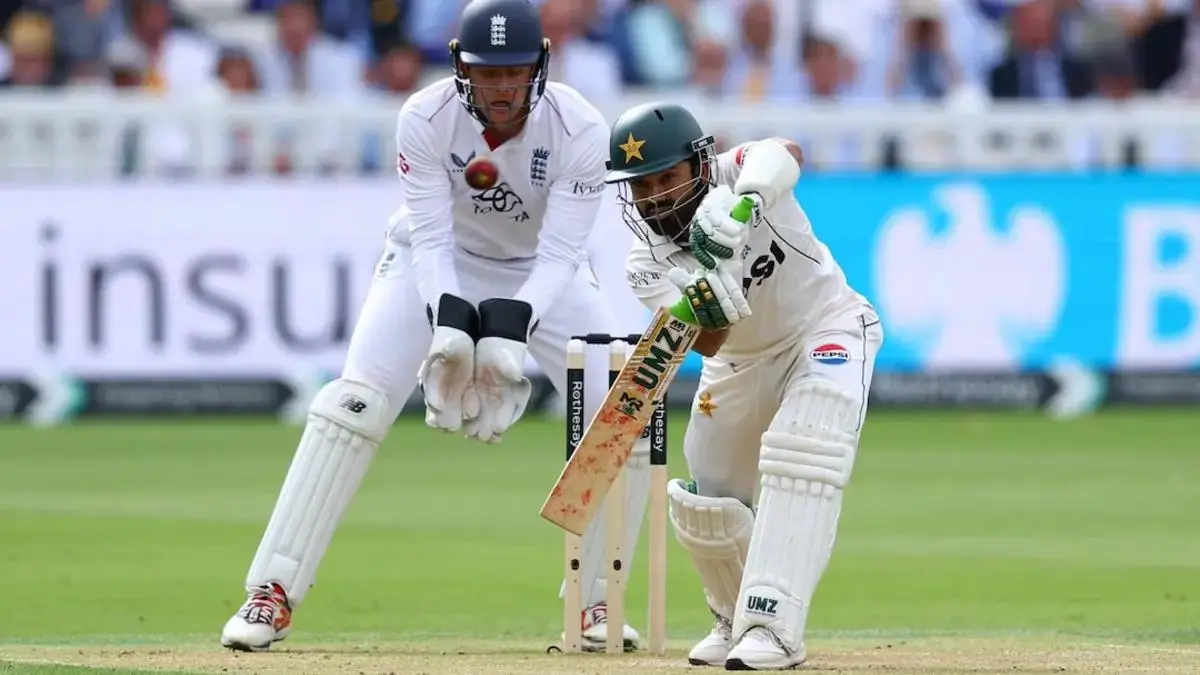
Pakistan have responded to a bruising Test tour of England with an extraordinary mid-series reset: a new coach, seven players sent home and seven replacements called up before the third and final match at Edgbaston.
Former Pakistan captain Sarfaraz Ahmed has been removed as red-ball head coach only months after taking the job. White-ball coach Mike Hesson will take charge for the third Test, which begins in Birmingham on September 9.
The personnel changes are just as sweeping. Mohammad Rizwan, Salman Ali Agha, Imam-ul-Haq, Ali Usman, Aamer Jamal, Awais Zafar and Khurram Shahzad will leave the squad. Saim Ayub, Abdullah Fazal, Arafat Minhas, Mohammad Imran Junior, Saad Baig, Mohammad Imran Randhawa and Razaullah have been drafted in.
The changes follow two one-sided defeats that gave England an unassailable 2-0 lead. Pakistan lost the first Test by an innings and 103 runs, then went down by 194 runs at Lord's. No Pakistan innings in the series has reached 200.
What Pakistan changed before the third Test
The Pakistan Cricket Board's decision affects both the leadership group and the balance of the playing squad.
Coach out
- Sarfaraz Ahmed has been replaced as red-ball head coach.
- Mike Hesson, already responsible for Pakistan's white-ball teams, will oversee the third Test.
Players leaving the tour
- Mohammad Rizwan
- Salman Ali Agha
- Imam-ul-Haq, who is injured
- Ali Usman
- Aamer Jamal
- Awais Zafar
- Khurram Shahzad
Players joining the squad
- Saim Ayub
- Abdullah Fazal
- Arafat Minhas
- Mohammad Imran Junior
- Saad Baig
- Mohammad Imran Randhawa
- Razaullah
The scale of the reshuffle makes this more than routine rotation in a lost series. Pakistan are using the final Test to change the environment around the team, expose younger players to English conditions and test options before their next red-ball assignment.
Why did Pakistan act so dramatically?
The scorelines explain much of the urgency. England did not merely win the first two Tests; they controlled them for long stretches and repeatedly exposed Pakistan's fragile batting.
At Lord's, Pakistan were set 413 to win and dismissed for 218. Saud Shakeel's 97 was the only innings that seriously delayed England. Ollie Robinson finished the match with eight wickets and reached 16 for the series, repeatedly finding ways through Pakistan's top and middle order.
Pakistan's failure to score 200 in any of their four completed innings points to a collective problem rather than one player having a bad tour. The top order has struggled to survive the new ball, partnerships have been too short, and the lower order has rarely rescued an innings.
The decision to send Rizwan and Salman home is especially significant because both are experienced players. It signals that reputation alone will not protect a place when the team is losing heavily. Imam's injury explains one departure, but the wider changes amount to a performance review conducted before the series has even finished.
There is also a practical selection reason. With the series already lost, playing an unchanged side at Edgbaston would offer Pakistan little new information. Bringing in younger batters, wicketkeepers and bowling options gives the selectors evidence they can use beyond this tour.
What Mike Hesson inherits
Hesson has no gentle introduction. He takes control of a red-ball side short on confidence, midway through an overseas series, with only days to prepare a substantially altered squad.
His immediate task is not to rebuild Pakistan Test cricket in one match. It is to simplify roles and make the side competitive again.
First, Pakistan need a batting plan that can survive England's seam attack. That means leaving well outside off stump, reducing low-percentage drives early in an innings and treating the first 30 overs as a distinct phase. England have been able to attack because wickets have arrived in clusters; stopping those collapses matters more than trying to score at England's tempo.
Second, Hesson must settle the wicketkeeping position after Rizwan's departure. Saad Baig and Muhammad Ghazi Ghori are listed as wicketkeeping options in the revised squad. Choosing between youth, batting depth and readiness for English conditions will shape the final XI.
Third, Pakistan must decide whether the new arrivals are genuinely in contention or simply gaining experience. If the purpose of the reshuffle is evaluation, at least several replacements need meaningful roles at Edgbaston.
Finally, Hesson must protect the authority of captain Babar Azam. A coaching change during a series can blur responsibility. Clear communication over selection, batting positions and on-field tactics will be essential if Pakistan are to avoid carrying uncertainty into the match.
Pakistan's updated squad for Edgbaston
The revised 17-player squad is:
Babar Azam (captain), Abdullah Fazal, Abdullah Shafique, Arafat Minhas, Azan Awais, Mohammad Abbas, Mohammad Ali, Muhammad Imran, Mohammad Imran Junior, Muhammad Ghazi Ghori (wicketkeeper), Razaullah, Saad Baig (wicketkeeper), Saim Ayub, Sajid Khan, Saud Shakeel, Shan Masood and Ubaid Shah.
The mix is notable. Babar, Saud and Shan provide Test experience in the batting group, while Saim Ayub offers an aggressive option at the top. Mohammad Abbas remains the most seasoned specialist seamer, and Sajid Khan offers the principal spin option.
Several call-ups are uncapped or lightly exposed at international level. That creates excitement but also risk. English Test conditions can be unforgiving, and Edgbaston crowds traditionally give the home side a loud advantage. Pakistan's newcomers will be asked to learn while the team is under intense scrutiny.
The biggest selection questions
Who opens the batting?
Abdullah Shafique, Saim Ayub and the new batting options give Pakistan several combinations. Saim can change the rhythm of an innings, but his attacking instincts must be balanced against the need to see off the new ball. Pakistan may prefer one naturally aggressive opener alongside a steadier partner rather than asking both players to counterattack.
Who keeps wicket?
Rizwan's departure guarantees a change behind the stumps. Saad Baig is a highly regarded young wicketkeeper-batter, while Ghazi Ghori is also included as a keeper. The choice will reveal whether Pakistan prioritise long-term development or the player they consider best equipped for this specific Test.
Does Pakistan refresh the pace attack?
Khurram Shahzad and Aamer Jamal leaving opens space for a different seam combination. Abbas's control should remain valuable, particularly if overhead conditions help movement. The question is who supplies pace, bounce and enough wicket-taking threat at the other end.
Can Saud Shakeel carry his Lord's form forward?
Shakeel's 97 was Pakistan's strongest batting performance of the second Test. He showed the patience and judgement the rest of the lineup often lacked. Edgbaston gives him a chance to convert that resistance into a century and become the anchor around whom a reshaped batting order can operate.
When and where is the third Test?
The final England-Pakistan Test is scheduled for September 9-13, 2026, at Edgbaston in Birmingham.
England have already secured the series, so the match will not decide the trophy. It still carries considerable weight. England can complete a 3-0 sweep, while Pakistan can prevent a whitewash and establish a more credible direction under Hesson.
For the new players, it is an opportunity to enter the Test side without the series result resting entirely on their shoulders. For the established names who remain, it is a chance to demonstrate that they should be central to the next phase rather than part of the next round of changes.
What this means beyond one Test
Pakistan have often changed captains, coaches and selection combinations after disappointing results. The harder challenge is turning a dramatic reaction into a coherent plan.
Hesson's appointment for Edgbaston may be presented as an immediate solution, but the board will soon need to clarify whether he is a temporary red-ball coach or the long-term leader across formats. Coaching every format can create consistency, yet it also adds workload and can reduce the specialist attention Test cricket requires.
The selectors must also define what success looks like for the seven incoming players. One difficult Test in England should not become a final judgement on a young cricketer. If these call-ups are part of a genuine transition, the players need a run of opportunities and a clear development programme after the tour.
For Babar, the situation is delicate. He remains captain of a squad being transformed around him. A stronger performance at Edgbaston would reinforce his leadership; another heavy defeat would intensify questions about the team's tactics and direction even though the board has already changed the coach and half the supporting cast.
Can Pakistan avoid a 3-0 series defeat?
Yes, but they need a fundamentally different batting performance. Reaching 300 in the first innings would give the bowlers a realistic game to defend. Pakistan also need to take early wickets instead of allowing England's middle order to dictate the pace.
The week between Tests gives Hesson time to reset expectations, but not enough to redesign techniques. The most realistic improvements are tactical: better shot selection, clearer bowling plans, sharper fielding and calmer decision-making when England apply pressure.
Edgbaston will therefore be both a Test match and an audition. The scoreboard will matter, but so will the evidence of whether Pakistan's new combination can compete with greater discipline than the side seen in the first two matches.
Pakistan's response has been bold. The third Test will show whether it was also constructive.
Sources
- Reuters: Pakistan replace coach and seven players before third England Test, August 31, 2026
- Reuters: England beat Pakistan by 194 runs at Lord's, August 30, 2026
- England and Wales Cricket Board: England v Pakistan third Test match information
- Edgbaston: England v Pakistan Test dates and venue information
Thumbnail photo: Action Images via Reuters/Matthew Childs.


