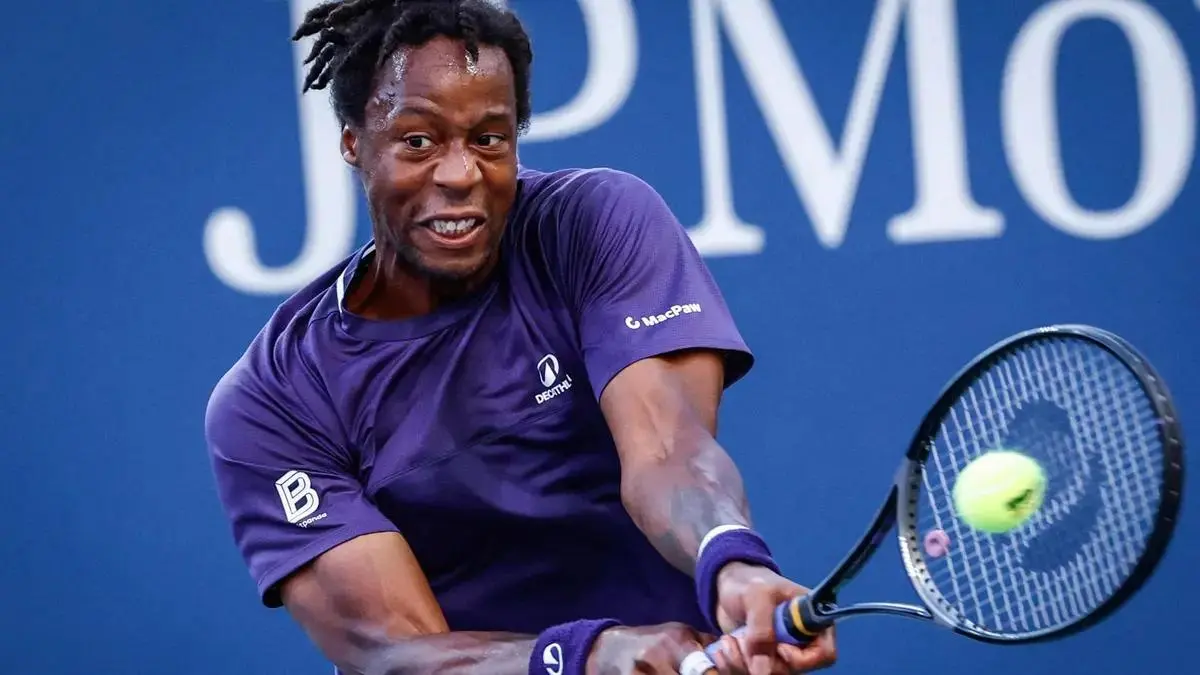
Gael Monfils celebrated his 40th birthday in the way only he could: recovering from a difficult opening set, energising a New York crowd and extending his final US Open with a four-set victory over Adolfo Daniel Vallejo.
The French wildcard won 2-6, 6-1, 6-2, 6-0 at Louis Armstrong Stadium. The result made him the oldest man to win a US Open main-draw singles match since Jimmy Connors, who also achieved the feat at 40 in 1992.
Monfils has confirmed that 2026 will be his final season. Every tournament now carries the possibility of a last appearance, which made this comeback feel larger than an ordinary first-round win.
How the match changed
Vallejo began with greater control and took the first set 6-2. Monfils looked short of rhythm, while the younger player handled the early exchanges without being distracted by the crowd's support for the veteran.
The match turned quickly in the second set. Monfils improved his return position, lengthened rallies and began using changes of pace to prevent Vallejo from dictating. Once the Frenchman found his timing, the scoreline moved decisively: 6-1, 6-2 and 6-0 across the final three sets.
That progression was a reminder of Monfils's variety. His reputation is built on athletic defence and spectacular improvisation, but his longevity also comes from understanding when to absorb pace, when to attack and how to change the emotional rhythm of a match.
Why the birthday record matters
Professional tennis at 40 demands constant management of recovery, training load and injuries. Best-of-five-set Grand Slam matches make that challenge even greater. Monfils did not simply appear in the draw; he recovered after losing the first set and became stronger as the contest continued.
The Connors comparison adds historical context. Connors's famous late-career US Open performances became part of the tournament's identity. Monfils now has his own New York milestone, achieved on the exact day he entered his fifth decade.
He was previously ranked world No. 6 and reached the US Open semifinal in 2016. A major title has eluded him, but career importance cannot be measured only through trophies. Few players of his generation have created such a direct connection with spectators.
The crowd as part of the performance
Louis Armstrong Stadium responded to every sprint, slide and recovery. Monfils has always treated crowd energy as something to use rather than block out. That relationship can be risky when emotion creates rushed decisions, but against Vallejo it became a source of momentum.
After the match, he thanked supporters for the atmosphere and described the night as special. The farewell context means fans understand there may not be another chance to see him at the tournament.
The performance also contrasted with Stan Wawrinka's farewell from Grand Slam tennis one day earlier. Their generation is gradually leaving the stage, even while players such as Novak Djokovic continue testing the limits of longevity.
Next opponent: Learner Tien
Monfils will face American Learner Tien in the second round. The matchup brings a sharp generational contrast: a 40-year-old playing his final US Open against one of the young players hoping to define the next era of American tennis.
Tien will present a different problem from Vallejo. He can redirect pace, compete patiently and will have significant home support of his own. Monfils must also recover physically after a four-set match, even though the final three sets were relatively quick.
The Frenchman will not be favoured to make a deep run through a demanding draw. That is not the only measure of success now. Each victory extends the farewell and creates one more match for a global fan base that has followed him for two decades.
A career larger than the result sheet
Monfils's best moments are frequently replayed as highlights: impossible retrievals, airborne forehands and celebrations that transform a stadium. Beneath those moments is a career requiring remarkable resilience.
He competed through the era of Roger Federer, Rafael Nadal, Djokovic and Andy Murray, when opportunities at the biggest tournaments were unusually limited. He still won titles, reached major semifinals and remained relevant across multiple generations.
The first round in New York captured that career in miniature. The start was uncomfortable, the solution required adaptation and the finish brought an entire crowd to its feet.
There will eventually be a final Monfils match. His 40th birthday ensured that it did not arrive in the first round of the 2026 US Open.
Source: Reuters match report.
